
Solids of Revolution (Disc Method)
Loading the math board and drawing, please wait…
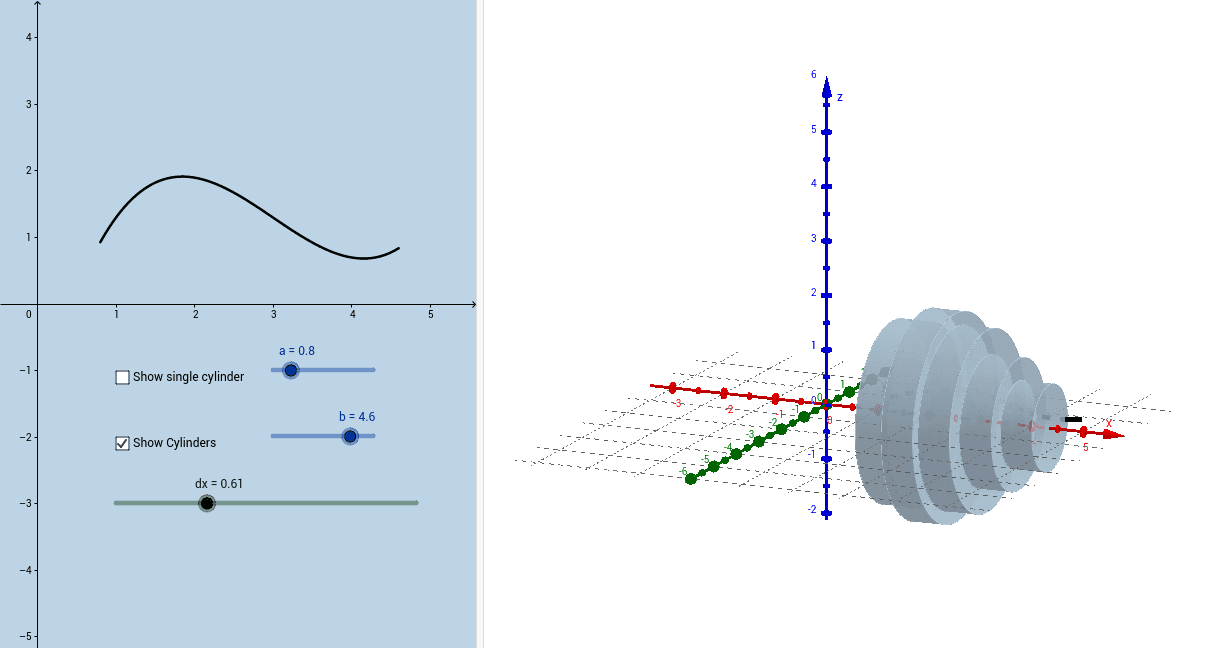
This example demonstrates the formation of solid of revolution using cylinders. ① It illustrates how a curve rotates around an axis to form a solid; ② Key math concepts include integral calculus, differential calculus, area calculation, and geometric transformations; ③ Construction highlights the use of GeoGebra commands like Function, Div, Sequence, and objects such as a, b, r, x_0, dx, D, f, E, r_1, singleCylinder, c, e, nsteps, cylinders; ④ Suitable for high school and above students learning integral applications and solid geometry.
GeoGebra Commands & Parameters
Function((((1 / 5 * (x - 1)) * (x - 3)) * (x - 5)) + 1.3, a, b) → fDiv(b - a, dx) → nstepsSequence({QuadricSide[Cylinder[(a + (dx * k), 0), (a + (dx * (k + 1)), 0), f(a + (dx * k))]], Top[Cylinder[(a + (dx * k), 0), (a + (dx * (k + 1)), 0), f(a + (dx * k))]], Bottom[Cylinder[(a + (dx * k), 0), (a + (dx * (k + 1)), 0), f(a + (dx * k))]]}, k, a, (b - a) / dx - 1) → cylinders
AI Drawing Prompt Reference
Draw a solid of revolution using the disc method around the x-axis. First, plot the function f(x) = ((1/5 * (x - 1)) * (x - 3)) * (x - 5) + 1.3 in the interval [a, b], then divide the function graph into n parts in this interval, each part forming a cylinder, and finally combine these cylinders to form a solid.
The prompt above was compiled from the original drawing commands and is for reference only.