
Solid with Circular Base and Isosceles Right Triangle Cross Sections
Loading the math board and drawing, please wait…
In collections
intersection: surface-surface, curve-curve
intersection: surface-surface, curve-curve
intersection: surface-surface, curve-curve
intersection: surface-surface, curve-curve
BC Calculus
Volumes in Calculus
Volumes in Calculus
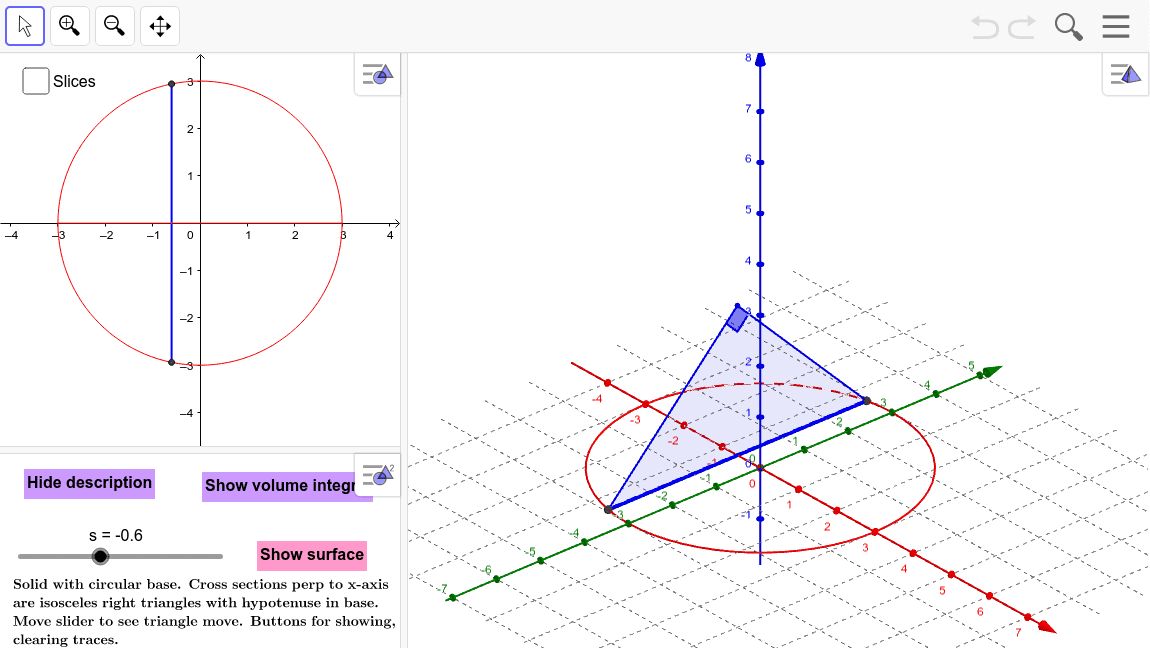
This example demonstrates a solid with a circular base and isosceles right triangle cross sections with the hypotenuse in the base. Key mathematical concepts include volume calculation in solid geometry. Using GeoGebra commands such as Circle, Polygon, Locus, and Integral, the solid can be constructed. Suitable for high school mathematics education or learning volume calculation in solid geometry.
GeoGebra Commands & Parameters
Circle((0, 0), 3) → cPolygon(C, B, A) → poly1, a_1, c_1, b_1Locus(C, s) → loc1Integral(9 - x^(2), -3, 3) → VolIntIf(togV ≟ 0, "Show volume integral", "Hide volume integral") → ShowVolIntegIf(togD ≟ 1, "Hide description", "Show description") → ShowDescripSurface(u, v / ((-f(u)) ≤ v ≤ f(u)), 0, v, -3, 3, u, -3, 3) → BaseIf(togS ≟ 1, "Hide surface", "Show surface") → ShowSurfaceAngle(A, C, B) → αSurface(u, (v * f(u)), f(u) - (v * f(u)), u, -3, 3, v, 0, 1) → SurfaceFrontSurface(u, ((-v) * f(u)), f(u) - (v * f(u)), u, -3, 3, v, 0, 1) → SurfaceBackSequence(Polygon[(-3 + (k * h), f(-3 + ((k + p) * h)), 0), (-3 + (k * h), (-f(-3 + ((k + p) * h))), 0), (-3 + ((k + 1) * h), (-f(-3 + ((k + p) * h))), 0), (-3 + ((k + 1) * h), f(-3 + ((k + p) * h)), 0)], k, 0, m - 1) → SlicesBaseSequence(Polygon[(-3 + (k * h), f(-3 + ((k + p) * h)), 0), (-3 + (k * h), (-f(-3 + ((k + p) * h))), 0), (-3 + (k * h), 0, f(-3 + ((k + p) * h)))], k, 0, m - 1) → SidesLeftSequence(Polygon[(-3 + ((k + 1) * h), f(-3 + ((k + p) * h)), 0), (-3 + ((k + 1) * h), (-f(-3 + ((k + p) * h))), 0), (-3 + ((k + 1) * h), 0, f(-3 + ((k + p) * h)))], k, 0, m - 1) → SidesRightSequence(Surface[-3 + ((k + u) * h), ((v - 1) * f(-3 + ((k + p) * h))), (v * f(-3 + ((k + p) * h))), u, 0, 1, v, 0, 1], k, 0, m - 1) → SlicesFrontSequence(Surface[-3 + ((k + u) * h), ((1 - v) * f(-3 + ((k + p) * h))), (v * f(-3 + ((k + p) * h))), u, 0, 1, v, 0, 1], k, 0, m - 1) → SlicesBackSequence(Area[Element[SidesLeft, k]], k, 1, m) → Areas