
Smile Bright Toothpaste Survey Probability & Statistics Example
Loading the math board and drawing, please wait…
This example demonstrates the graphical analysis of market survey data using probability and statistics methods. Core math concepts include probability statistics, sample analysis, and data visualization. Construction highlights from the GeoGebra command summary involve commands like slidevalue, Quadratic1, Linear1, DatakitBG, etc. Suitable for high school mathematics curriculum, teaching real-world applications of probability statistics and data analysis.
GeoGebra Commands & Parameters
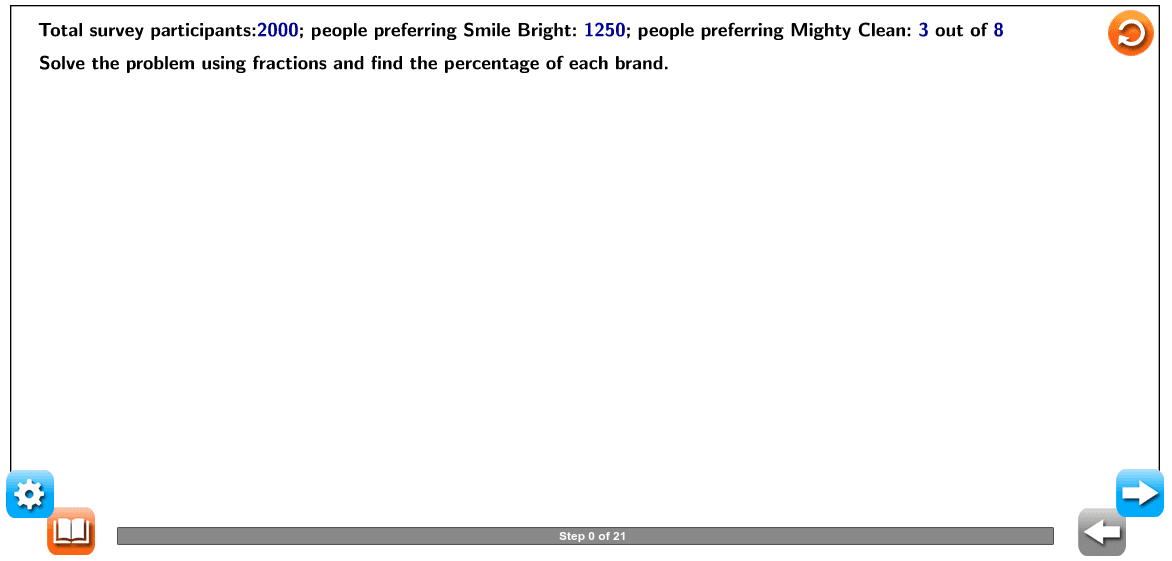
LaTeX("\text{Solve the problem using fractions and find the percentage of each brand.}") → content2LaTeX("\text{Write equivalent fractions in simplest form to represent the given values.}") → content3LaTeX((((("\text{The Mighty Clean ad says \textcolor{#000099}{ " * val4) * "} people out of \textcolor{#000099}{ ") * val5) * "} prefer Mighty Clean.}")) → content7LaTeX("\text{Compare the fractions.}") → content9LaTeX("\text{Use proportions to write each fraction as a percent.}") → content12LaTeX("\text{Proportion}") → content15LaTeX((((((("\text{\textcolor{#000099}{\frac{" * div1) * "}{") * div2) * "}=}\textcolor{#000099}{\frac{p}{") * val6) * "}}")) → content14LaTeX((((((("\text\textcolor{#000099}{{" * div1) * "(") * val6) * ")=") * div2) * "(p)}}")) → content16LaTeX("\text{Cross multiply.}") → content17LaTeX((((("\text\textcolor{#000099}{{" * Mul1) * "=") * div2) * "p}}")) → content18LaTeX("\text{Simplify.}") → content19LaTeX((("\text\textcolor{#000099}{{" * div4) * "=p}}")) → content20LaTeX("\text{Proportion}") → content25LaTeX((((((("\text{\textcolor{#000099}{\frac{" * val4) * "}{") * val5) * "}=}\textcolor{#000099}{\frac{p}{") * val6) * "}}")) → content24LaTeX((((((("\text\textcolor{#000099}{{" * val4) * "(") * val6) * ")=") * val5) * "(p)}}")) → content26LaTeX("\text{Cross multiply.}") → content29LaTeX("\text{Simplify.}") → content30LaTeX((("\text\textcolor{#000099}{{" * div5) * "=p}}")) → content28LaTeX((("\text{The percent of people surveyed who prefer Smile Bright is \textcolor{#000099}{ " * div3) * "%}.}")) → content32LaTeX((("\text{Divide both sides by \textcolor{#000099}{" * div2) * "}.}")) → content21LaTeX((((("\text\textcolor{#000099}{{" * Mul2) * "=") * val5) * "p}}")) → content27LaTeX((("\text{Divide both sides by \textcolor{#000099}{" * val5) * "}.}")) → content31LaTeX((("\text{The percent of people who reportedly prefer Mighty Clean is \textcolor{#000099}{ " * div5) * "%}.}")) → content22LaTeX((("\text{People preferring Smile Bright:" * Quadratic1) * "}")) → Datakittext1LaTeX((("\text{People preferring Mighty Clean:" * Quadratic2) * "}")) → Datakittext3LaTeX((((("\text{Total survey participants:\textcolor{#000099}{" * Linear1) * "}; people preferring Smile Bright: \textcolor{#000099}{") * Quadratic1) * "}; people preferring Mighty Clean: \textcolor{#000099}{3} out of \textcolor{#000099}{8}}")) → content1LaTeX((((("\text{In the Smile Bright survey, \textcolor{#000099}{" * Quadratic1) * "} people out of \textcolor{#000099}{ ") * Linear1) * "} prefer Smile Bright.}")) → content4LaTeX((((("\text{This can be written as the fraction \textcolor{#000099}{\frac{" * Quadratic1) * "}{") * Linear1) * "}}. }")) → content5LaTeX((((((((((("\text{The fraction \textcolor{#000099}{\frac{" * Quadratic1) * "}{") * Linear1) * "}} can be reduced by a factor of \textcolor{#000099}{") * slidevalue) * "}. The resulting fraction is \textcolor{#000099}{\frac{") * div1) * "}{") * div2) * "}}.}")) → content6LaTeX((((("\text{This can be written as the fraction \textcolor{#000099}{\frac{" * val4) * "}{") * val5) * "}}. }")) → content8LaTeX((((((((((((((((("\text{The fractions \textcolor{#000099}{\frac{" * div1) * "}{") * div2) * "}} and \textcolor{#000099}{\frac{") * val4) * "}{") * val5) * "}} have common denominators, so only their numerators need to be compared. Since \textcolor{#000099}{") * div1) * "} is greater than \textcolor{#000099}{") * val4) * "}, \textcolor{#000099}{\frac{") * div1) * "}{") * div2) * "}} is} ")) → content10LaTeX((((("\text{greater than \textcolor{#000099}{\frac{" * val4) * "}{") * val5) * "}}. Therefore, according to these results, more people said they prefer Smile Bright than Mighty Clean.}")) → content11LaTeX((((((((((("\text{The ratio of people surveyed who prefer Smile Bright is \textcolor{#000099}{ \frac{" * div1) * "}{") * div2) * "}}. Set up the proportion \textcolor{#000099}{\frac{") * div1) * "}{") * div2) * "}}=\textcolor{#000099}{\frac{p}{") * val6) * "}} to determine the equivalent percent.}")) → content13LaTeX((((((((((("\text{The ratio of people who reportedly prefer Mighty Clean is \textcolor{#000099}{\frac{" * val4) * "}{") * val5) * "}}. Set up the proportion \textcolor{#000099}{\frac{") * val4) * "}{") * val5) * "}=\frac{p}{") * val6) * "}} to determine the equivalent percent.}")) → content23LaTeX("\text{\mathbf{factor\;(noun)} one of two or more numbers or expressions that when multiplied}") → WordstoknowtextLaTeX("\text{produce a given product}") → Wordstoknowtext1LaTeX("\text{\mathbf{factor\; (verb)} to write an expression as the product of its factors}") → Wordstoknowtext2LaTeX((("\text{Total number of participants:" * Linear1) * "}")) → Datakittext2