
Slope: Run and Rise
Loading the math board and drawing, please wait…
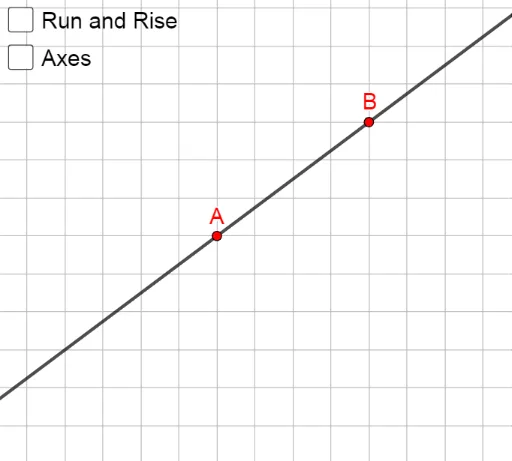
This example demonstrates calculating the slope of a line using 'run' (horizontal distance) and 'rise' (vertical distance). It involves core math concepts like coordinates, addition, means, percentages, and general quadrilaterals. Constructed using GeoGebra commands such as Line, Sequence, and If, it is suitable for middle school students and above learning coordinate geometry and function slopes, or for educational demonstrations.
GeoGebra Commands & Parameters
Line(A, B) → fSequence(Vector[A + (sgn(x(B) - x(A)) * (i, 0)), A + (sgn(x(B) - x(A)) * (i + 1, 0))], i, 0, abs(x(B) - x(A)) - 1) → l1Sequence(Vector[(x(B), y(A)) + (sgn(y(B) - y(A)) * (0, i)), (x(B), y(A)) + (sgn(y(B) - y(A)) * (0, i + 1))], i, 0, abs(y(B) - y(A)) - 1) → l2If(step1 ∧ b ∧ (GCD[run, rise] ≠ 1 ∨ run < 0 ∨ rise < 0), true, false) → showstep2