
Sliding Transformation
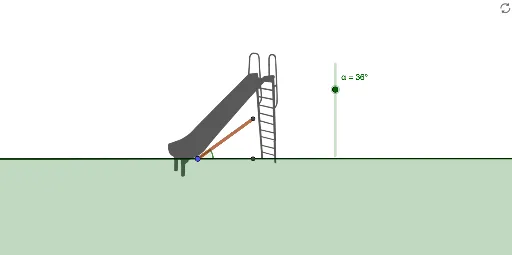
Loading the math board and drawing, please wait…
This example demonstrates sliding transformations of polygons. Key mathematical concepts include polygons, transformations, and slider animation. Using GeoGebra commands such as Line, OrthogonalLine, Rotate, and Intersect, a dynamic process of polygon transformation is constructed. Suitable for middle school and above students or teachers for geometry instruction.
GeoGebra Commands & Parameters
Line(A, B) → fOrthogonalLine(B, f) → gRotate(B, α, A) → B'Line(B', A) → hIntersect(g, h) → CSegment(C, A) → iLine(D, A) → jAngle(B, A, C) → α_{1}Rotate(D, (-(40°)), A) → D'_1Ray(A, D'_1) → lIntersect(g, j) → ESegment(C, E) → kPoint(j) → FLine(F, k) → mOrthogonalLine(C, m) → nIntersect(m, n) → G
AI Drawing Prompt Reference
Draw a horizontal line with two fixed points on it. From the second point, construct a perpendicular line. Rotate the second point around the first point by a variable angle to get a rotated point. Connect the rotated point to the first point, and intersect this line with the perpendicular to get a point. Connect this intersection to the first point with a segment. From another point, draw a line to the first point, intersecting the perpendicular at another point. Connect the two intersection points with a segment. Pick a point on the horizontal line, draw a line through it parallel to the last segment, then construct a perpendicular to this parallel line from the intersection point, meeting at a new point. The whole figure shows a sliding transformation of a polygon as the angle changes.
The prompt above was compiled from the original drawing commands and is for reference only.