
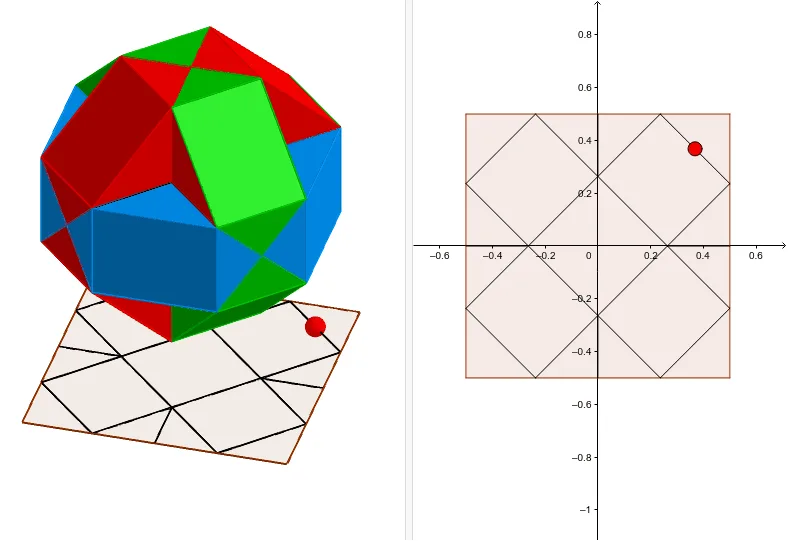
Skeletal Octahedron to Rhombicuboctahedron and Cube Transformation
Loading the math board and drawing, please wait…
This example demonstrates the transformation of a skeletal octahedron into a rhombicuboctahedron and a cube through variable manipulations. Key mathematical concepts include geometric transformations, spatial geometry, properties of polyhedra, and vector operations. The construction utilizes GeoGebra commands and objects such as Line, Point, Polygon, Intersect, OrthogonalLine, Segment, Rotate, Vector, Translate, Plane, and Mirror. It is suitable for high school and above students to explore polyhedral transformations and spatial geometric relationships dynamically.
GeoGebra Commands & Parameters
Line(D, B) → sLine(A, C) → ePoint(e) → EPolygon(A, B, C, D) → poly1, a, b, c, dIntersect(xAxis, yAxis) → OOrthogonalLine(E, e) → fIntersect(f, poly1) → F, GSegment(G, F) → gRotate(G, 90°, O) → G'Rotate(F, 90°, O) → F'Segment(G', F') → g'Rotate(G', 90°, O) → G''Rotate(F', 90°, O) → F''Segment(G'', F'') → g''Rotate(G'', 90°, O) → G'''Rotate(F'', 90°, O) → F'''Segment(G''', F''') → g'''Segment(F'', G) → hSegment(F', G''') → iSegment(F, G'') → jSegment(F''', G') → kIntersect(h, k) → HIntersect(i, j) → IIntersect(h, j) → JIntersect(i, h) → KIntersect(k, poly1) → L, MIntersect(j, k) → NLine(H, I) → lLine(N, K) → mIntersect(m, c) → PIntersect(l, m) → QIntersect(l, d) → RIntersect(m, a) → SIntersect(l, b) → TSegment(K, P) → nSegment(H, R) → pSegment(N, S) → qSegment(I, T) → rPoint(zAxis) → UVector(O, U) → vTranslate(A, v) → A'Translate(B, v) → B'Translate(C, v) → C'Translate(D, v) → D'Polygon(A', B', C', D') → poly1', a', b', c', d'Translate(F'', v) → F'''_1Translate(G, v) → G'_1Segment(F'''_1, G'_1) → h'_2Translate(F, v) → F'_2Translate(G'', v) → G'''_1Segment(F'_2, G'''_1) → j'Translate(G'', v) → G'''_2Translate(F'', v) → F'''_2Segment(G'''_2, F'''_2) → g'''_3Translate(G, v) → G'_2Translate(F, v) → F'_3Segment(G'_2, F'_3) → g'_1Translate(G', v) → G''_1Translate(F', v) → F''_1Segment(G''_1, F''_1) → g''_2Translate(F', v) → F''_2Translate(G''', v) → VSegment(F''_2, V) → i'_1Translate(F''', v) → WTranslate(G', v) → G''_2Segment(W, G''_2) → k'_1Translate(G''', v) → ZTranslate(F''', v) → A_1Segment(Z, A_1) → tTranslate(H, v) → H'_1Translate(R, v) → R'Segment(H'_1, R') → p'Translate(K, v) → K'_1Translate(P, v) → P'Segment(K'_1, P') → n'_4Translate(N, v) → N'_1Translate(S, v) → S'Segment(N'_1, S') → q'Translate(I, v) → I'_1Translate(T, v) → T'Segment(I'_1, T') → r'Translate(E, v) → E'Rotate(F'_2, 90°, i'_1) → B_1Vector(I'_1, B_1) → uPolygon(H'_1, N'_1, I'_1, K'_1) → poly2, h'_1, n'_1, i'_2, k'_2Translate(U, u) → U'Translate(K'_1, u) → C_1Polygon(U', B_1, C_1) → poly3, c_1, u', b_1Polygon(K'_1, C_1, G'_1) → poly4, g'_2, k'_3, c_2Polygon(C_1, G'_1, F'_2, B_1) → poly5, c_3, g'_3, f'_2, b_2Polygon(B_1, I'_1, F'_2) → poly6, f'_1, b_3, i'_3Rotate(poly6, 90°, zAxis) → gpoly6'Rotate(G'_1, 90°, zAxis) → D_1Rotate(K'_1, 90°, zAxis) → E_1Segment(D_1, E_1) → a_1Rotate(poly5, 90°, zAxis) → gpoly5'Rotate(poly3, 90°, zAxis) → gpoly3'Rotate(poly4, 90°, zAxis) → gpoly4'Rotate(gpoly3', 90°, zAxis) → poly3''Rotate(gpoly4', 90°, zAxis) → poly4''Rotate(gpoly5', 90°, zAxis) → poly5''Rotate(gpoly6', 90°, zAxis) → poly6''Rotate(poly6'', 90°, zAxis) → poly6'''Rotate(poly3'', 90°, zAxis) → gpoly3'''Rotate(poly5'', 90°, zAxis) → gpoly5'''Rotate(poly4'', 90°, zAxis) → gpoly4'''Rotate(B', -90°, t) → B''Rotate(A', -90°, g'''_3) → A''Rotate(D', (-(90°)), g''_2) → D''Plane(D'', A'', B'') → oMirror(poly3, o) → poly3'_1Mirror(gpoly3', o) → gpoly3''_1Mirror(poly3'', o) → poly3'''_1Mirror(gpoly3''', o) → gpoly7Mirror(poly4, o) → poly4'_1Mirror(gpoly4', o) → gpoly4''_1Mirror(poly4'', o) → poly4'''_1Mirror(gpoly4''', o) → gpoly8Mirror(poly5, o) → poly5'_1Mirror(gpoly5', o) → gpoly5''_1Mirror(poly5'', o) → poly5'''_1Mirror(gpoly5''', o) → gpoly9Mirror(poly6, o) → poly6'_1Mirror(gpoly6', o) → gpoly6''_1Mirror(poly6'', o) → poly6'''_1Mirror(poly6''', o) → gpoly10Line(B'', D'') → d_1Rotate(gpoly4', -90°, d_1) → bpoly4''_2Rotate(poly3'', -90°, d_1) → poly3'''_2Rotate(poly3, -90°, d_1) → poly3'_2Rotate(gpoly5', -90°, d_1) → bpoly5''_2Rotate(gpoly6', -90°, d_1) → bpoly6''_2Rotate(gpoly3', -90°, d_1) → bpoly3''_2Rotate(gpoly3''', -90°, d_1) → bpoly11Rotate(bpoly5''_2, -90°, zAxis) → bpoly12Rotate(bpoly12, -90°, zAxis) → bpoly12'Rotate(bpoly12', -90°, zAxis) → bpoly12''Rotate(bpoly6''_2, -90°, zAxis) → bpoly13Rotate(bpoly13, -90°, zAxis) → bpoly13'Rotate(bpoly13', -90°, zAxis) → bpoly13''Mirror(bpoly6''_2, o) → bpoly14Mirror(bpoly13, o) → bbpoly13'_1Mirror(bpoly13', o) → bpoly13''_1Mirror(bpoly13'', o) → bpoly13'''Rotate(poly3'_2, -90°, zAxis) → gpoly15Rotate(gpoly15, -90°, zAxis) → poly15'Rotate(poly15', -90°, zAxis) → gpoly15''Rotate(bpoly11, -90°, zAxis) → bpoly11'Rotate(bpoly11', -90°, zAxis) → bpoly11''Rotate(bpoly11'', -90°, zAxis) → bpoly11'''Rotate(poly3'''_2, -90°, zAxis) → poly16Rotate(poly16, -90°, zAxis) → poly16'Rotate(poly16', -90°, zAxis) → gpoly16''Rotate(bpoly3''_2, -90°, zAxis) → bpoly17Rotate(bpoly17, -90°, zAxis) → bpoly17'Rotate(bpoly17', -90°, zAxis) → bpoly17''
AI Drawing Prompt Reference
Draw a spatial quadrilateral skeleton with four vertices, whose diagonals intersect at the origin. Pick a point on one diagonal, draw a line through it perpendicular to that diagonal, intersecting the quadrilateral at two points; connect these points to form a segment. Rotate this segment around the origin three times by 90 degrees each, yielding four symmetric segments that outline an octagonal region. Connect endpoints of adjacent rotated segments to create four crossing segments, which intersect the quadrilateral sides and each other, producing multiple intersection points. Connect these points to form an inner polygonal structure. Finally, translate the entire quadrilateral vertically to create a second quadrilateral, and connect corresponding vertices between the two quadrilaterals to form a 3D framework, illustrating the transformation from an octahedron to a cube.
The prompt above was compiled from the original drawing commands and is for reference only.