
Simplifying Geometric Figures Using Exponent Rules
Loading the math board and drawing, please wait…
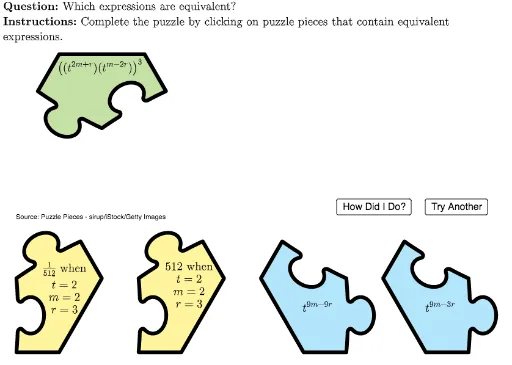
This example demonstrates how to simplify geometric figures using exponent rules. The key mathematical concepts involved include exponent operations and geometric transformations. Construction involves using GeoGebra commands such as Element, LaTeX, Text and objects like questionListIndex, questionList. It is suitable for middle or high school mathematics teaching to practice exponent rules in geometry.
GeoGebra Commands & Parameters
Element(questionList, questionListIndex) → questionNumLaTeX(UnicodeToLetter[10003]) → cmarkLaTeX(UnicodeToLetter[10007]) → xmarkElement(C2:C6, questionNum) → correctRightTextElement(B2:B6, questionNum) → correctLeftTextElement(E2:E6, questionNum) → incorrectRightTextElement(D2:D6, questionNum) → incorrectLeftTextElement(A2:A6, questionNum) → questionTextElement(F2:F6, questionNum) → feedbackLaTeX((((("\text{" * QUESTION) * "\\") * INSTRUCTIONS) * "}")) → TEXTLaTeX("\dfrac{(2x^2y^3)^5}{(4x^4y)(y^{12})}") → A2LaTeX("\dfrac{(x^3)(\sqrt[4]{x})}{(\sqrt{x})^7}") → A4LaTeX("\left(\dfrac{x}{y}\right)^2(-x^2y)^3") → A5LaTeX("\left((t^{2m+r})(t^{m-2r})\right)^3") → A6LaTeX("\left(\hspace{-4}\dfrac{x^3}{(x^2)(x^{-4})}\hspace{-4}\right)^{-2}") → A3LaTeX("8x^6y^2") → B2LaTeX("\dfrac{1}{x^{10}}") → B3LaTeX("\dfrac{1}{x^{\frac{1}{4}}}") → B4LaTeX("-x^8y") → B5LaTeX("t^{9m-3r}") → B6LaTeX("\dfrac{x^6y^2}{2}") → D2LaTeX("\dfrac{1}{x^2}") → D3LaTeX("\dfrac{1}{x^4}") → D4LaTeX("x^8y") → D5LaTeX("t^{9m-9r}") → D6LaTeX("\begin{tabular}{c}72\\\text{when}\\x=-1\\y=3\end{tabular}") → C2LaTeX("\begin{tabular}{c}-72\\\text{when}\\x=-1\\y=3\end{tabular}") → E2LaTeX("\begin{tabular}{c}-5\\\text{when}\\x=-1\\y=5\end{tabular}") → C5LaTeX("\begin{tabular}{c}5\\\text{when}\\x=-1\\y=5\end{tabular}") → E5LaTeX("\begin{tabular}{c}\tfrac{1}{1024}\\\text{when}\\x=2\end{tabular}") → C3LaTeX("\begin{tabular}{c}\tfrac{1}{4}\\\text{when}\\x=2\end{tabular}") → E3LaTeX("\begin{tabular}{c}\tfrac{1}{2}\\\text{when}\\x=16\end{tabular}") → C4LaTeX("\begin{tabular}{c}\tfrac{1}{65~536}\\\text{when}\\x=16\end{tabular}") → E4LaTeX("\begin{tabular}{c}512\text{ when}\\t=2\\m=2\\r=3\end{tabular}") → C6LaTeX("\begin{tabular}{c}\tfrac{1}{512}\text{ when}\\t=2\\m=2\\r=3\end{tabular}") → E6Text(If[isLeftCorrect, correctLeftText, incorrectLeftText], puzzleAnchor + (3.75, 5), true, true) → matchedLeftTextText(If[isRightCorrect, correctRightText, incorrectRightText], puzzleAnchor + (9.5, 8.75), true, true) → matchedRightText
AI Drawing Prompt Reference
Draw a geometric figure that demonstrates the simplification of exponent operations in geometry. The figure includes a coordinate system, points, line segments, and regions, with corresponding exponent expressions annotated as text. The construction order is: first establish the coordinate system, then add points, line segments, and regions, and finally annotate the expressions in appropriate locations. The figure should clearly show the simplification of geometric figures using exponent rules.
The prompt above was compiled from the original drawing commands and is for reference only.