
Simple Reflection Example
Loading the math board and drawing, please wait…
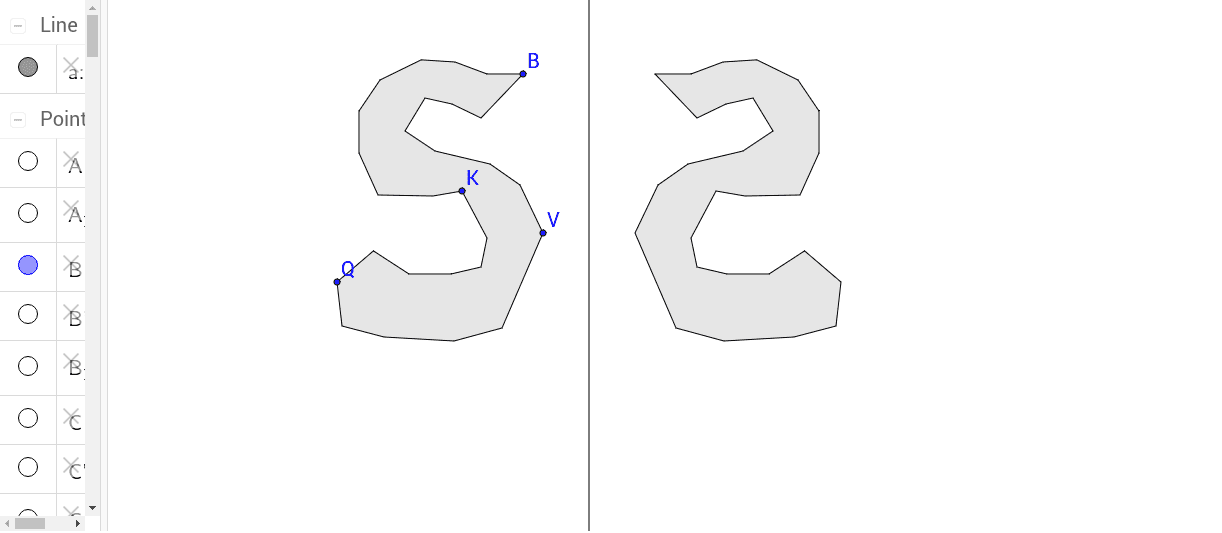
This example demonstrates the basic principle of reflection transformation. Key mathematical concepts include reflection, similarity transformation, and dilation. Using GeoGebra commands such as Point, OrthogonalLine, Polygon, and Mirror, the reflection transformation effect can be constructed. Suitable for students at junior high school level and above to learn about reflection and similarity transformations.
GeoGebra Commands & Parameters
Point(xAxis) → AOrthogonalLine(A, xAxis) → aPolygon(B, C, L, M, N, O, P, Q, R, S, T, U, D, V, W, Z, A_1, B_1, C_1, D_1, E_1, E, F, G, H, I, J, K) → poly1, b, k, l, m, n, o, p, q, r, s, t, c, u, v, w, z_1, a_1, b_1, c_1, d_1, e_1, d, e, f, g, h, i, jMirror(B, a) → B'Mirror(C, a) → C'Mirror(D, a) → D'Mirror(E, a) → E'Mirror(F, a) → F'Mirror(G, a) → G'Mirror(H, a) → H'Mirror(I, a) → I'Mirror(J, a) → J'Mirror(K, a) → K'Mirror(L, a) → L'Mirror(M, a) → M'Mirror(N, a) → N'Mirror(O, a) → O'Mirror(P, a) → P'Mirror(Q, a) → Q'Mirror(R, a) → R'Mirror(S, a) → S'Mirror(T, a) → T'Mirror(U, a) → U'Mirror(V, a) → V'Mirror(W, a) → W'Mirror(Z, a) → Z'Mirror(A_1, a) → F_1Mirror(B_1, a) → G_1Mirror(C_1, a) → H_1Mirror(D_1, a) → I_1Mirror(E_1, a) → J_1Polygon(B', C', L', M', N', O', P', Q', R', S', T', U', D', V', W', Z', F_1, G_1, H_1, I_1, J_1, E', F', G', H', I', J', K') → poly1', b', k', l', m', n', o', p', q', r', s', t', c', u', v', w', z', f_1, g_1, h_1, i_1, j_1, d', e', f', g', h', i', j'
AI Drawing Prompt Reference
Draw a coordinate system, then take a point A on the x-axis and draw a perpendicular line a to the x-axis. Take several points B, C, D, E, F, G, H, I, J, L, M, N, O, P, Q, R, S, T, U, V, W, Z on line a, and their reflections B', C', D', E', F', G', H', I', J', L', M', N', O', P', Q', R', S', T', U', V', W', Z' across the x-axis. Finally, use these points to draw two polygons.
The prompt above was compiled from the original drawing commands and is for reference only.