
Simple Harmonic Motion
Loading the math board and drawing, please wait…
In collections
UQ-Applied Mathematical Analysis
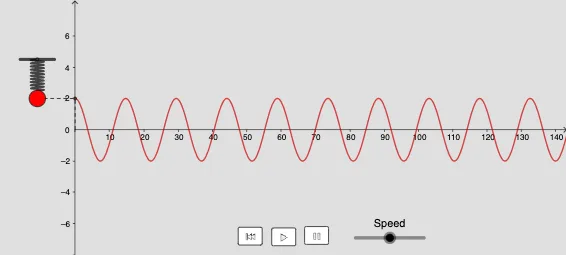
This example demonstrates the displacement-time graph and dynamic behavior of Simple Harmonic Motion. Core mathematical concepts include differential equations, function graphing, trigonometry, and parametric equations. Construction highlights involve GeoGebra commands like Element, CurveCartesian, Segment, Textfield, LaTeX, with objects such as sliders (b, m, k, ω_0), buttons, and lists for interactive exploration. Suitable for high school physics and mathematics education to illustrate vibration phenomena and mathematical modeling.
GeoGebra Commands & Parameters
Element(List, index) → SolutionCurveCartesian((2 * sin((((10 * 2) * π) * (j - y_1) / y_l))) + x(B), j, j, y_1, y_0) → SSegment(PS, PS + (0, 0.5)) → endCurveCartesian((2 * sin((((10 * 2) * π) * (j - y_1) / y_l))) + x(B), j, j, y_0, y_1) → SauxSegment(C1, C2) → PlataformSegment(A, A') → LevelSegment((t, 0), A') → LevelTimeTextfield(a) → InputBox1Textfield(b) → InputBox2LaTeX(ω_0, true, true) → text1Textfield(m) → InputBox3Textfield(k) → InputBox4