
Similar Right Triangles (II)
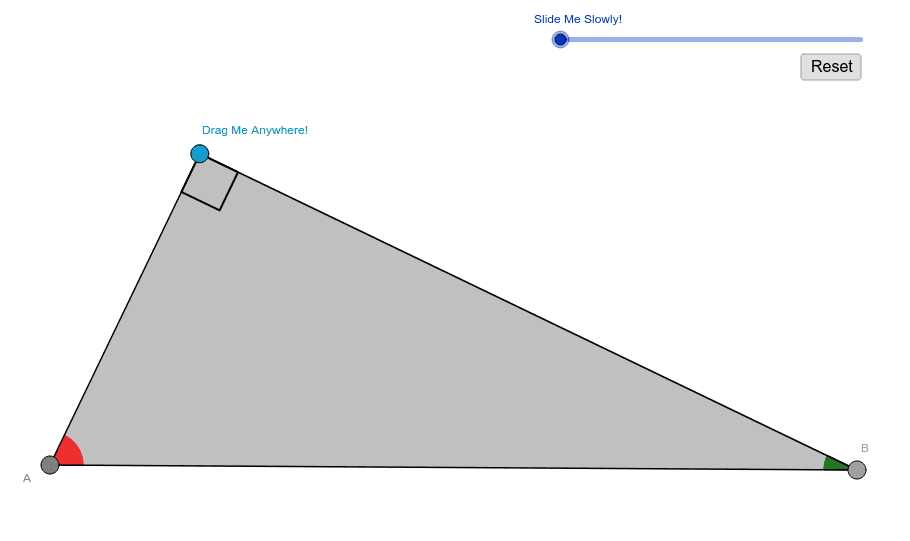
Loading the math board and drawing, please wait…
This example demonstrates the phenomenon where two smaller right triangles formed by drawing an altitude to the hypotenuse of a right triangle are similar to each other and to the original triangle. It involves core math concepts like similarity criteria for triangles, properties of right triangles, and trigonometric functions. The construction uses GeoGebra commands such as Segment, Midpoint, OrthogonalLine, Circle, Semicircle, Point, Intersect, Angle, Polygon, CircleSector, Dilate, Vector, Translate, Rotate, CircleArc. It is suitable for high school students to understand the similarity theorem and its practical applications.
GeoGebra Commands & Parameters
Segment(A, B) → aMidpoint(a) → C_1OrthogonalLine(C_1, a) → bCircle(C_1, A) → cSemicircle(A, B) → dPoint(d) → CSegment(A, C) → eSegment(C, B) → fOrthogonalLine(C, a) → gIntersect(g, a) → ESegment(C, E) → hAngle(B, E, C) → αAngle(A, C, B) → βPolygon(A, E, C) → poly1, d_1, a_1, e_1Polygon(E, B, C) → poly2, d_2, e_2, b_1Circle(A, 1) → kCircle(C, 1) → pCircle(B, 1) → qIntersect(p, e_1, 1) → FIntersect(a_1, b_1) → GIntersect(a_1, b_1) → HIntersect(p, h, 1) → IIntersect(p, f, 1) → JIntersect(q, a, 1) → KIntersect(q, f, 1) → LIntersect(k, a, 1) → MIntersect(k, e, 1) → NCircleSector(A, M, N) → rDilate(C, If[-2 < i < -1, -1 - i, 0], E) → D'Segment(C, D') → jCircleSector(C, I, J) → sCircleSector(B, L, K) → tCircleSector(C, F, I) → c_1Angle(C, E, A) → γDilate(A, If[-0.5 < i < 0.5, 0.5 - i, 1], C) → A'Vector(A, A') → uTranslate(r, u) → r'Rotate(r', If[-0.5 < i < 0.5, (((-(i + 0.5)) * 90))°], A') → r''CircleArc(A, M, N) → f_1Dilate(B, If[0.5 < i < 1.5, 1.5 - i], C) → B'Vector(B, B') → vTranslate(t, v) → t'Rotate(t', If[0.5 < i < 1.5, (((i - 0.5) * 90))°], B') → t''CircleArc(B, L, K) → g_1Polygon(A, B, C) → poly3, d_3, a_2, b_2