
Similar Quadrilaterals: Geometric Transformation and Properties Demo
Loading the math board and drawing, please wait…
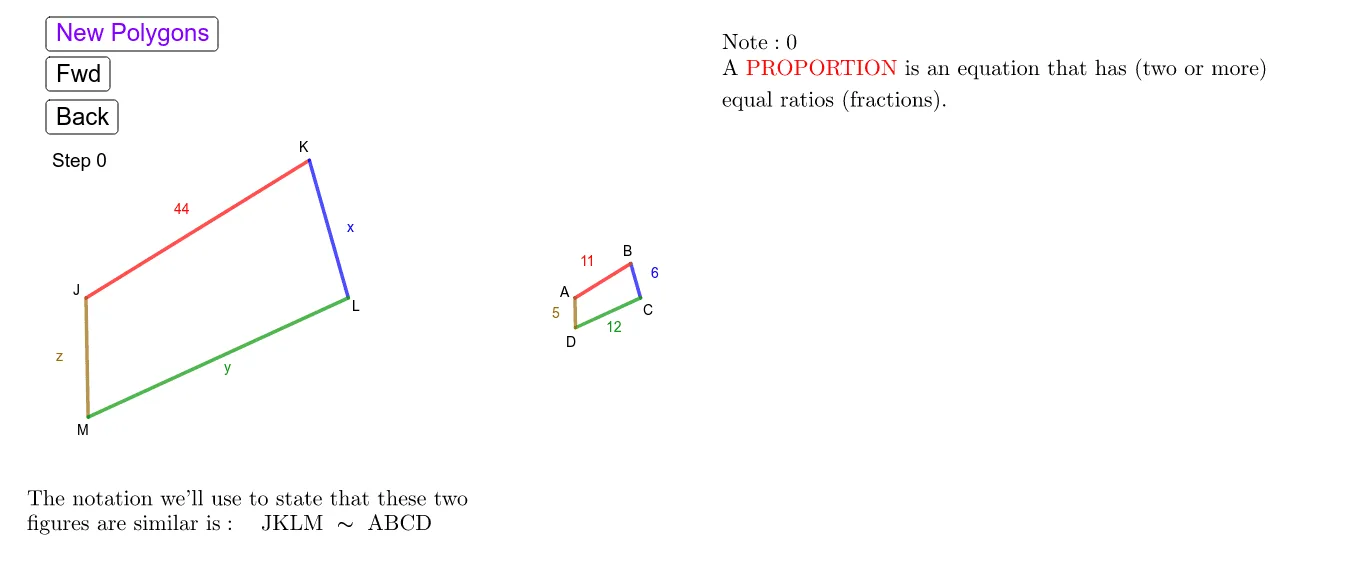
This example demonstrates the definition and properties of similar quadrilaterals. It covers core concepts like similarity ratio, corresponding angles, proportional sides, and homothety. Construction uses GeoGebra commands including Point, Circle, Intersect, and Segment. Interactive sliders control scaling factors, while buttons manage polygon reset and step navigation. Ideal for middle or high school students studying plane geometry and similarity transformations.
GeoGebra Commands & Parameters
Point(xAxis) → JCircle(J, b_1) → circle_{p1}Intersect(circle_{p1}, xAxis, 2) → LSegment(J, L) → g_1Circle(L, a_1) → circle_{p2}Circle(J, c_1) → circle_{p3}Intersect(circle_{p2}, circle_{p3}, 2) → KSegment(J, K) → fSegment(L, K) → kCircle(J, e_1) → pCircle(L, d_1) → qIntersect(p, q, 2) → MSegment(J, M) → rSegment(M, L) → sPoint(xAxis) → ACircle(A, b) → tIntersect(t, xAxis, 2) → CCircle(C, a) → hCircle(A, c) → c_1Intersect(h, c_1, 2) → BSegment(C, B) → iSegment(B, A) → lSegment(A, C) → mCircle(A, e) → f_1Circle(C, d) → h_1Intersect(f_1, h_1, 2) → DSegment(D, C) → nSegment(A, D) → j