
Proportional Polygons
Loading the math board and drawing, please wait…
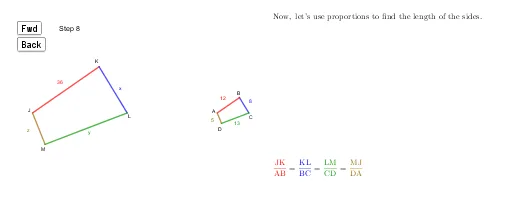
This example demonstrates the dynamic construction of proportional polygons, visually illustrating the proportional relationships between side lengths, areas, and other properties of polygons. Key mathematical concepts include proportionality, similar polygons, matrix operations, and integer calculations. Construction highlights involve commands like Point, Circle, Intersect, Segment, with variables factor_1, factor_2 controlling proportions, and button_{New Polygon} for polygon generation, alongside matrix operations for geometric transformations. Suitable for high school mathematics education, particularly for understanding similarity and geometric transformations, or for computational geometry teaching purposes.
GeoGebra Commands & Parameters
Point(xAxis) → JCircle(J, b_1) → circle_{p1}Intersect(circle_{p1}, xAxis, 2) → LSegment(J, L) → g_1Circle(L, a_1) → circle_{p2}Circle(J, c_1) → circle_{p3}Intersect(circle_{p2}, circle_{p3}, 2) → KSegment(J, K) → fSegment(L, K) → kCircle(J, e_1) → pCircle(L, d_1) → qIntersect(p, q, 2) → MSegment(J, M) → rSegment(M, L) → sPoint(xAxis) → ACircle(A, b) → tIntersect(t, xAxis, 2) → CCircle(C, a) → hCircle(A, c) → c_1Intersect(h, c_1, 2) → BSegment(C, B) → iSegment(B, A) → lSegment(A, C) → mCircle(A, e) → f_1Circle(C, d) → h_1Intersect(f_1, h_1, 2) → DSegment(D, C) → nSegment(A, D) → j