
Similar Polygons: IM 8.2.7 Lesson
Loading the math board and drawing, please wait…
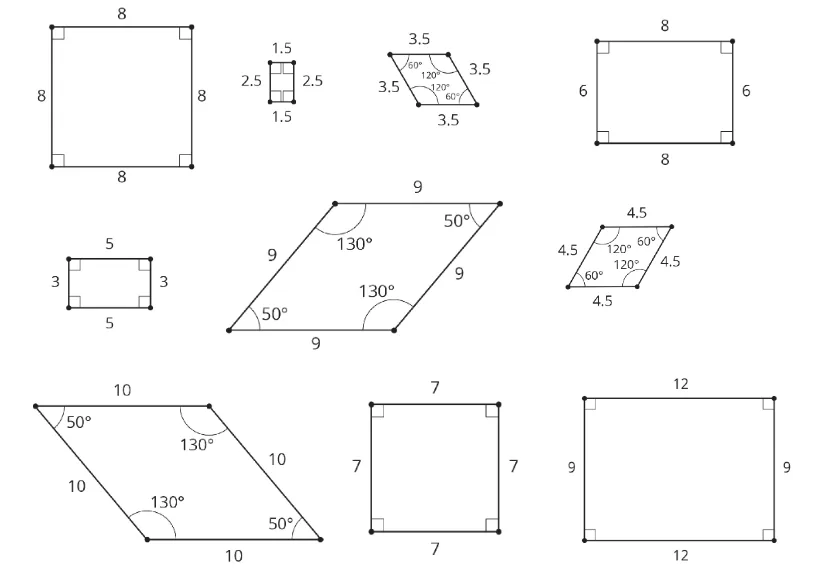
This GeoGebra example demonstrates the concept of similar polygons through multiple pairs of images (pic1 to pic10) with corresponding vertices (A to T). It visually shows how two polygons can have the same shape but different sizes. The core mathematical concept is the definition of similar polygons: corresponding angles are equal and corresponding sides are proportional. The construction uses point objects (A, B, C, D, etc.) and image objects (pic1 to pic10) to create multiple sets of similar figures, likely allowing users to drag or transform to observe scale changes. This is suitable for 8th-grade students learning properties of similar polygons, and can be used for classroom demonstrations or self-exploration to understand similarity ratios and correspondence.
GeoGebra Commands & Parameters
Point A(0.08092518656232572, 5.202196458956287)Point B(4.08092518656232, 5.202196458956287)Point C(-0.2499417462752369, -2.5772255858186712)Point D(4.7500582537247595, -2.5772255858186712)Point E(-10.264740149249862, 2.05514448880626)Point F(-7.264740149249862, 2.05514448880626)Point G(-6.4411559104500835, 6.036762992537507)Point H(-4.4411559104500835, 6.036762992537507)Point I(-4.4411559104500835, -2.5588440895499183)Point J(-0.4411559104500835, -2.5588440895499183)Point K(-10.451049173766943, 4.653010353274611)Point L(-6.451049173766943, 4.653010353274611)Point M(-4.010982294781442, 5.816185037312467)Point N(-1.0109822947814422, 5.816185037312467)Point O(-0.45213820523152504, 2.128670473881274)Point P(2.678672392997538, 2.1438481005432846)Point Q(-6.879186966534479, 1.4130322211588893)Point R(-0.8791869665344785, 1.4130322211588893)Point S(-10.595607082087424, -2.448555111937398)Point T(-4.595607082087424, -2.448555111937398)
AI Drawing Prompt Reference
Draw ten pairs of similar polygons, each pair consisting of two polygons with the same shape but different sizes. The first pair is two rectangles, one above and one below, with corresponding vertices aligned. The second pair is two trapezoids, a smaller one on the left and a larger one on the right, with parallel bases. The third pair is two irregular quadrilaterals, one upper-left and one lower-right, with equal corresponding angles. The fourth pair is two triangles, one on the left and one on the right, with proportional side lengths. The fifth pair is two pentagons, one upper-left and one lower-right, similar in shape. All polygons have vertices marked with points, and corresponding vertices are ordered consistently to clearly show the similarity relationship.
The prompt above was compiled from the original drawing commands and is for reference only.