
Similar Polygons by mathspace
Loading the math board and drawing, please wait…
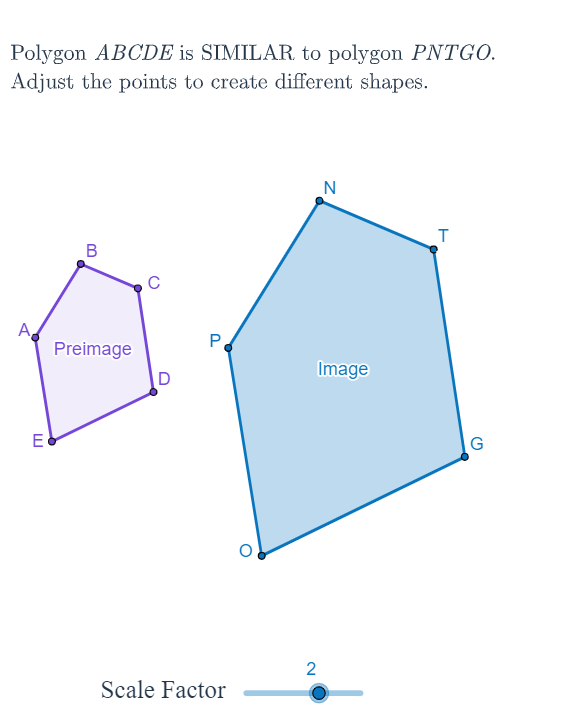
This example demonstrates the concept of similar polygons. By using vectors and translation, similar polygons can be constructed. The construction involves commands such as Polygon, Vector, Translate, and Dilate. Suitable for middle school and above students to learn about similar transformations and geometric construction.
GeoGebra Commands & Parameters
Polygon(A, B, C, D, E) → poly1, a, b, c, d_1, eVector(A, F) → uTranslate(A, u) → A'Translate(B, u) → B'Translate(C, u) → C'Translate(D, u) → D'Translate(E, u) → E'Polygon(A', B', C', D', E') → poly1', a', b', c', d', e'Dilate(A', d, G_1) → PDilate(B', d, G_1) → NDilate(C', d, G_1) → TDilate(D', d, G_1) → GDilate(E', d, G_1) → OPolygon(P, N, T, G, O) → poly1'', a'', b'', c'', d'', e''
AI Drawing Prompt Reference
Draw two similar polygons, where one is obtained by translating another using a vector, and the other is derived by scaling and translating the second one. Start by drawing a pentagon, then translate it using a vector to create a second pentagon. Next, scale each vertex of the second pentagon from a point by a certain ratio, and connect these scaled vertices to form a third pentagon, demonstrating the concept of similar transformations.
The prompt above was compiled from the original drawing commands and is for reference only.