
Sicherman Dice Proof Using Factoring
Loading the math board and drawing, please wait…
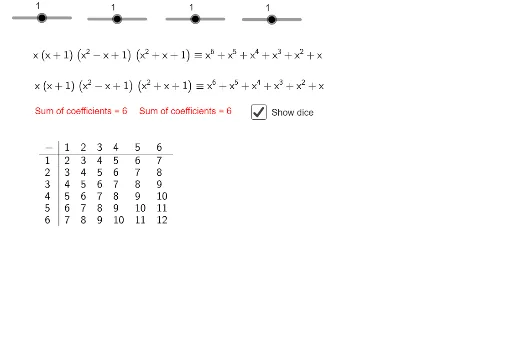
This example demonstrates the uniqueness of Sicherman Dice through a proof involving factoring. Key math concepts include polynomial factoring, coefficients, and probability statistics. GeoGebra commands used are Factor, Polynomial, Coefficients, Flatten, Sequence, TableText, and Sum. Suitable for high school and above students interested in probability theory and algebraic applications.
GeoGebra Commands & Parameters
Factor(r) → tPolynomial(t) → ttCoefficients(tt) → l2Flatten(Sequence[Sequence[j, i, 1, Element[l2, j]], j, 1, Length[l2]]) → l4Factor(q) → sPolynomial(s) → ssCoefficients(ss) → l1Flatten(Sequence[Sequence[j, i, 1, Element[l1, j]], j, 1, Length[l1]]) → l3Sequence(Sequence[Element[l5, i] + Element[l6, j], i, 1, Length[l3]], j, 1, Length[l4]) → m1Sequence(Sequence[If[i ≟ 0 ∧ j ≟ 0, "+", If[i ≟ 0, "" + (Element[l6, j]), If[j ≟ 0, "" + (Element[l5, i]), "" + (Element[m1, j, i])]]], i, 0, Length[l3]], j, 0, Length[l4]) → m2TableText(m2, "_01000000000000000000000000000000000000|01000000000000000000000000000000000000") → text8Sum(Coefficients[ss]) → sumSSSum(Coefficients[tt]) → sumTT