
Sets and Subsets: The Basics with Venn Diagrams
Loading the math board and drawing, please wait…
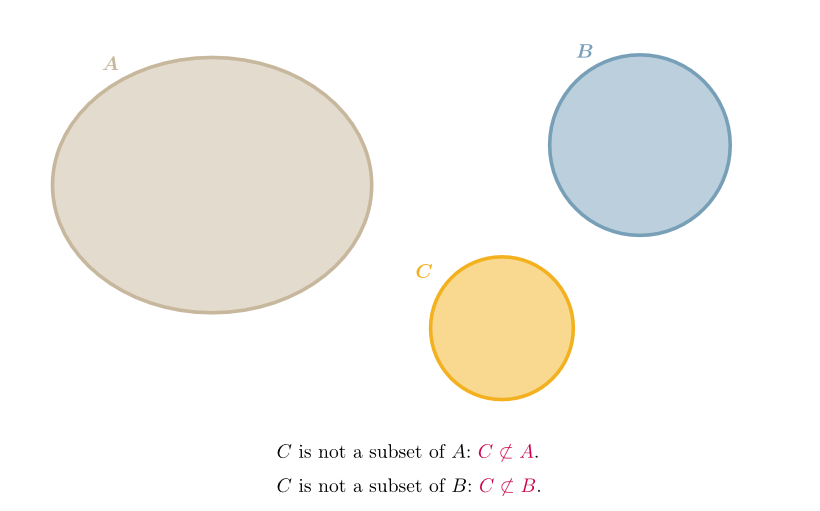
①This example demonstrates the fundamental concepts of sets and subsets using interactive Venn diagrams, showing how elements belong to sets and how subsets relate to supersets. ②Core mathematical concepts include set membership, subset relations, set operations (intersection, union, complement), and logical implications between set inclusions. ③Construction details: The GeoGebra commands used are Point (to create element points), Sequence (to generate ordered lists), and Zip (to pair elements with sets). Key objects include sets a, b, c; element points B, C; rotated points rotB, rotC; boolean objects like BinA, BsubsC, CinA, and text objects textSummaryA, textSummaryB, textSummaryC that dynamically display relationship summaries. ④This is suitable for middle school to high school students learning set theory basics, as well as introductory discrete mathematics courses, providing an intuitive visual approach to understanding subset logic and set operations.
GeoGebra Commands & Parameters
Point(b) → BPoint(c) → CSequence(Rotate[B, t, Center[b]], t, 0, (2 * pi), pi / 12) → rotBSequence(Rotate[C, t, Center[c]], t, 0, (2 * pi), pi / 12) → rotCSequence(Point[a, t / n], t, 1, n) → rotAZip(IsInRegion[P, a], P, rotB) → BinAZip(IsInRegion[P, c], P, rotB) → BinCZip(IsInRegion[P, a], P, rotC) → CinAZip(IsInRegion[P, b], P, rotC) → CinB
AI Drawing Prompt Reference
Draw a Venn diagram with three sets, a, b, and c. Represent each set with a colored circle. Place element points like B and C inside the circles. Rotate these points to create rotB and rotC. Show relationships such as intersections and complements. The diagram should be clear to help understand set and subset concepts.
The prompt above was compiled from the original drawing commands and is for reference only.