
Geometric Comparison of Fractions (Construction-Based)
Loading the math board and drawing, please wait…
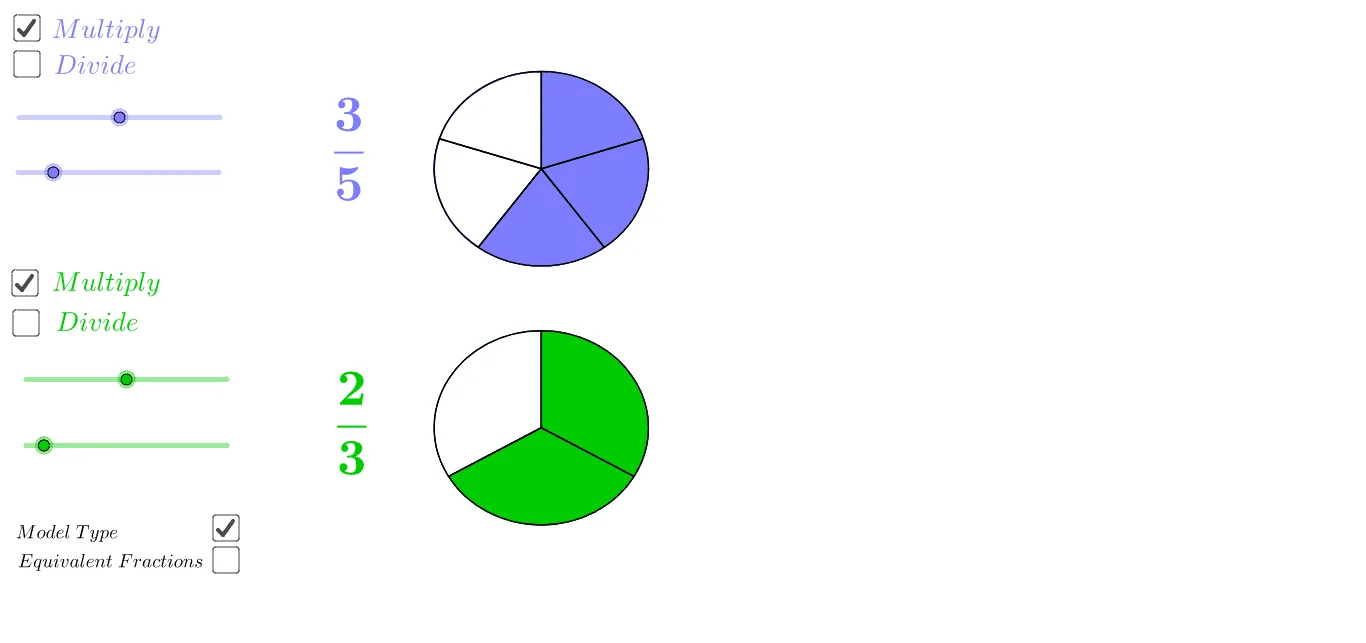
This example demonstrates, via visual geometry, how to compare the sizes of fractions (or equivalent rational ratios) by constructing relationships between geometric objects. It centers on core concepts such as rational numbers, fraction magnitude comparison, and number-to-geometry translation using segment/ratio representations. The construction leverages the provided commands and objects: If for conditional logic, Division for computing fraction/ratio values, Intersect and Point to locate critical intersection points used for comparison, Circle to define relevant curves/constraints, and Translate together with Sequence to generate structured positions or stepwise progression. It also uses BarFraction to display fractions in a bar/segment form and Improp for handling specific constructed relationships. Lists (e.g., list1, list2, list4, list5, list7, list10, list11, list3) and text labels (text*) are used to organize computed values and annotate key results. Suitable for middle and high school learning—especially for teaching fraction comparison and “numbers through diagrams” style geometric construction.
GeoGebra Commands & Parameters
If(m, (a_1 * b), If[d, a_1 / b, If[a, a_1 + b, If[s, a_1 - b]]]) → iIf(m, (n * g), If[d, n / g, If[a, n + g, If[s, n - g]]]) → jDivision(a_1, n) → list8Intersect(xAxis, yAxis) → APoint(yAxis) → BSequence(Rotate[B, (((-i) * 360) * ° / n), A], i, 0, n) → list1Circle(A, B) → cSequence(Rotate[D, (((-i) * 360) * ° / If[m, (n * g), If[d, n / g, If[a, n + g, If[s, n - g]]]]), C], i, 0, If[m, (n * g), If[d, n / g, If[a, n + g, If[s, n - g]]]]) → list4Circle(C, D) → fSequence(Sector[c, Element[list1, i + 1], Element[list1, i]], i, 1, n) → list2Sequence(Sector[f, Element[list4, i + 1], Element[list4, i]], i, 1, If[m, (n * g), If[d, n / g, If[a, n + g, If[s, n - g]]]]) → list5Division(i, j) → list11If(n > a_1, Sequence[Sector[c, Element[list1, i + 1], Element[list1, i]], i, 1, a_1], Sequence[Sector[c, Element[list1, i + 1], Element[list1, i]], i, 1, a_1]) → list3Circle(E, G) → pCircle(F, H) → qSequence(Rotate[G, (((-i) * 360) * ° / o), E], i, 0, o) → list14Sequence(Sector[p, Element[list14, i + 1], Element[list14, i]], i, 1, o) → list12If(l > o, Sequence[Sector[p, Element[list14, i + 1], Element[list14, i]], i, 1, l], Sequence[Sector[p, Element[list14, i + 1], Element[list14, i]], i, 1, l]) → list15Sequence(Sector[p, Element[list14, i + 1], Element[list14, i]], i, 1, o) → list16Sequence(Rotate[H, (((-i) * 360) * ° / If[u, (o * t), If[w, o / t, If[a, o + t, If[s, o - t]]]]), F], i, 0, If[u, (o * t), If[w, o / g, If[a, o + t, If[s, o - t]]]]) → list17Sequence(Sector[q, Element[list17, i + 1], Element[list17, i]], i, 1, If[u, (o * t), If[w, o / t, If[a, o + t, If[s, o - t]]]]) → list18If(u, (l * r), If[w, l / r, If[a, a_1 + b, If[s, a_1 - b]]]) → b_1If(u, (o * t), If[w, o / t, If[a, n + g, If[s, n - g]]]) → c_1Division(b_1, c_1) → list20Sequence(Element[list10, i] - (0, 8), i, 1, Length[list10]) → list22If(j ≥ i, Sequence[Sector[f, Element[list4, n + 1], Element[list4, n]], n, 1, i], Sequence[Sector[f, Element[list4, i + 1], Element[list4, i]], i, 1, Element[list11, 2]]) → list6If(i > j, Sequence[Circle[Element[list10, i], 0.8], i, 0, Element[list11, 1], 1]) → list9If(b_1 > c_1, Sequence[Circle[Element[list22, i], 0.8], i, 0, Element[list20, 1], 1]) → list21Translate({list3, list15}, (v, 0)) → list13Translate({list6}, (0, g_1)) → list23BarFraction(a_1, n, I) → list24, list25BarFraction(l, o, J) → list26, list27If(m ≟ 1, (a_1 * b), a_1 / b) → r_5If(m ≟ 1, (n * g), n / g) → s_5If(u ≟ 1, (o * t), o / t) → v_5If(u ≟ 1, (l * r), l / r) → t_5Translate(list24, (v, ((1 / 20 * v) * (v - 8)))) → list25'Translate(list26, (v, ((1 / 20 * v) * (v - 8)))) → list26'If(c_1 ≥ b_1, Sequence[Sector[q, Element[list17, o + 1], Element[list17, o]], o, 1, b_1], Sequence[Sector[q, Element[list17, i + 1], Element[list17, i]], i, 1, Element[list20, 2]]) → list19Improp(v_5, t_5, L) → list31_3, list31, list32If(t_5 > v_5, Sequence[Polygon[P - (0, i), P - (0, i) + (3, 0), P - (0, i) + (3, 0.5), P - (0, i) + (0, 0.5)], i, 0, Element[list32, 1] - 1]) → list30If(t_5 > v_5, Sequence[Polygon[P - (0, i), P - (0, i) + (3, 0), P - (0, i) + (3, 0.5), P - (0, i) + (0, 0.5)], i, 0, Element[list32, 1] - 1]) → list33Improp(s_5, r_5, K) → list28, list29, list34If(r_5 > s_5, Sequence[Polygon[O - (0, i), O - (0, i) + (3, 0), O - (0, i) + (3, 0.5), O - (0, i) + (0, 0.5)], i, 0, Element[list34, 1] - 1]) → list35If(r_5 > s_5, Sequence[Polygon[O - (0, i), O - (0, i) + (3, 0), O - (0, i) + (3, 0.5), O - (0, i) + (0, 0.5)], i, 0, Element[list34, 1] - 1]) → list36If(i > j, Sequence[Circle[Element[list10, i], 0.8], i, 0, Element[list11, 1], 1]) → list37If(b_1 > c_1, Sequence[Circle[Element[list22, i], 0.8], i, 0, Element[list20, 1], 1]) → list38Translate(list28, (0, (1.045 * g_1))) → list28'
AI Drawing Prompt Reference
Draw a geometric diagram comparing two fractions. Create two concentric circles centered at the origin, each representing a fraction. Divide each circle into equal sectors corresponding to the denominator, and fill the number of sectors equal to the numerator. Compare the filled areas to show which fraction is larger. Below the circles, draw two horizontal bars, each divided into segments matching the denominator, with the numerator segments shaded. Use the bar lengths for additional comparison. Annotate the numeric values of the fractions and their ratio nearby, and include a text label indicating the comparison result. Keep the layout clear for educational purposes.
The prompt above was compiled from the original drawing commands and is for reference only.