
Sequence of Rigid Motions to Show Congruence
Loading the math board and drawing, please wait…
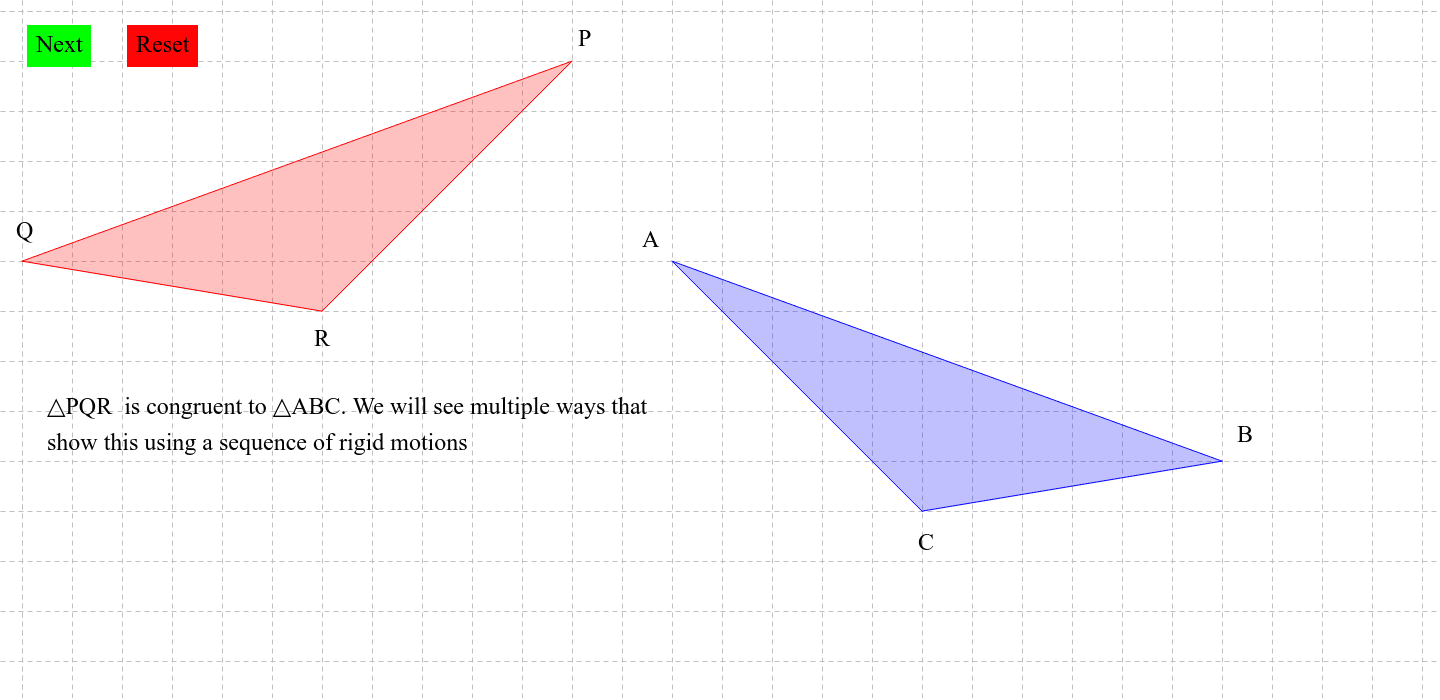
This example demonstrates how to prove the congruence of a figure using a sequence of rigid motions. It involves core mathematical concepts such as rigid transformations and geometric congruence. The construction utilizes GeoGebra commands and objects like Polygon, Vector, Translate, Point, Line, Mirror, and Segment. It is suitable for high school mathematics education, helping students understand and apply properties of rigid motions and congruence.
GeoGebra Commands & Parameters
Polygon(A, B, C) → poly1, c, a, bVector(C, D) → uTranslate(A, u) → A'Translate(B, u) → B'Translate(C, u) → C'Polygon(A', B', C') → poly1', c', a', b'Point(u) → EVector(C, E) → vTranslate(A, v) → A'_1Translate(B, v) → B'_1Translate(C, v) → C'_1Polygon(A'_1, B'_1, C'_1) → poly1'_1, c'_1, a'_1, b'_1Line(D, F) → dMirror(A', d) → A''Mirror(B', d) → B''Mirror(C', d) → C''Polygon(A'', B'', C'') → poly1'', c'', a'', b''Mirror(A'_1, d) → GMirror(B'_1, d) → HMirror(C'_1, d) → IPolygon(G, H, I) → poly2, i, g, hMirror(A, d) → A'_2Mirror(B, d) → B'_2Mirror(C, d) → C'_2Polygon(A'_2, B'_2, C'_2) → poly1'_2, c'_2, a'_2, b'_2Line(J, d) → eVector(J, K) → wMirror(A'_1, e) → LMirror(B'_1, e) → MMirror(C'_1, e) → NPoint(w) → OVector(J, O) → zTranslate(L, f) → L'Translate(M, f) → M'Translate(N, f) → N'Translate(L', z) → L''Translate(M', z) → M''Translate(N', z) → N''Translate(A'_2, z) → PTranslate(B'_2, z) → QTranslate(C'_2, z) → RMirror(A, e) → A'_3Mirror(B, e) → B'_3Mirror(C, e) → C'_3Polygon(A'_3, B'_3, C'_3) → poly1'_3, c'_3, a'_3, b'_3Translate(A'_3, z) → STranslate(B'_3, z) → TTranslate(C'_3, z) → UPolygon(S, T, U) → poly3, u_1, s, tSegment(E, D) → jMirror(A'_1, d) → VMirror(B'_1, d) → WMirror(C'_1, d) → ZPolygon(V, W, Z) → poly4, z_1, v_1, w_1Vector(A_1, D) → kMirror(E, d) → E'Segment(E', D) → lVector(C'_3, D) → mSegment(A, B) → nSegment(B, C) → pSegment(C, A) → qTranslate(C, w) → C'_4Vector(C, C'_4) → rPoint(r) → B_1Vector(C, B_1) → a_1Translate(A, a_1) → A'_4Translate(B, a_1) → B'_4Translate(C, a_1) → C'_5Polygon(A'_4, B'_4, C'_5) → poly1'_4, c'_5, a'_4, b'_4Segment(B_1, C'_4) → b_1Translate(A, r) → A'_5Translate(B, r) → B'_5Segment(A'_5, B'_5) → n'Translate(B, r) → B'_6Translate(C, r) → C'_6Segment(B'_6, C'_6) → p'Translate(C, r) → C'_7Translate(A, r) → A'_6Segment(C'_7, A'_6) → q'Mirror(A'_4, e) → C_1Mirror(B'_4, e) → D_1Mirror(C'_5, e) → E_1Polygon(C_1, D_1, E_1) → poly5, e_1, c_1, d_1Segment(E, D) → f_1Line(M_1, N_1) → g_1Segment(O, K) → h_1
AI Drawing Prompt Reference
Draw a polygon and demonstrate its congruence through a sequence of rigid motions like translations and reflections. First, translate the polygon to a new position, then reflect it across a line. Finally, show the congruence through multiple transformations and reflections, highlighting the concepts of rigid motions and congruence.
The prompt above was compiled from the original drawing commands and is for reference only.