
Self-Moving Vector
Loading the math board and drawing, please wait…
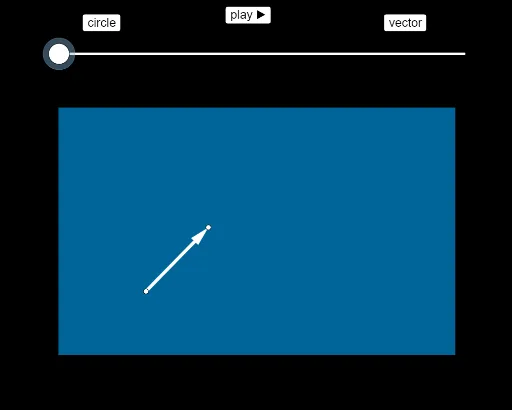
This example demonstrates the dynamic movement of a self-moving vector. Key mathematical concepts include vectors and their movement in a plane. Using commands like If, Intersect, Polygon, Translate, etc., a self-moving vector model is constructed. Suitable for high school mathematics education and learning vector transformations.
GeoGebra Commands & Parameters
If(a ≟ true, y = Ly + r, y = Ly) → l_1If(a ≟ true, x = (-r), x = 0) → j_1Intersect(j_1, l_1) → GIf(a ≟ true, x = Lx + r, x = Lx) → i_1Intersect(i_1, l_1) → HIf(a ≟ true, y = (-r), y = 0) → k_1Intersect(i_1, k_1) → IIntersect(j_1, k_1) → JPolygon(G, H, I, J) → q1, g_2, h_2, i_2, j_2Translate(B, cb) → B1Translate(C, cb) → C1If(x(B1) < 0, (-x(B1)), If[x(B1) > Lx, (2 * Lx) - x(B1), x(B1)]) → xBIf(x(B1) < 0, (-x(C1)), If[x(B1) > Lx, (2 * Lx) - x(C1), x(C1)]) → xCIf(y(B1) < 0, (-y(B1)), If[y(B1) > Ly, (2 * Ly) - y(B1), y(B1)]) → yBIf(y(B1) < 0, (-y(C1)), If[y(B1) > Ly, (2 * Ly) - y(C1), y(C1)]) → yCCircle(B3, r) → cVector(C3, B3) → u