
Second Fundamental Theorem of Calculus: Visual Link Between Definite Integrals a
Loading the math board and drawing, please wait…
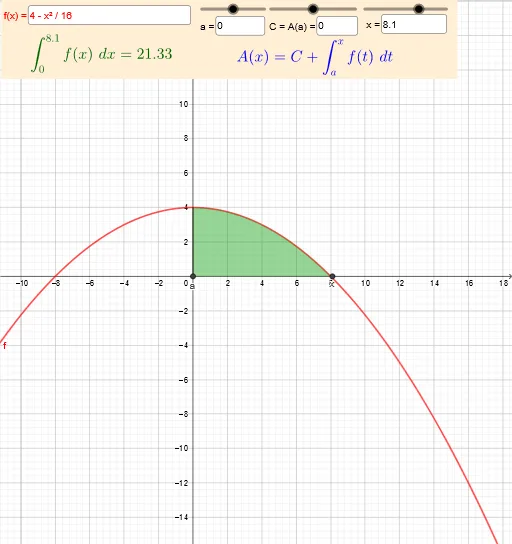
This GeoGebra example visually demonstrates the Second Fundamental Theorem of Calculus: defining a function by a definite integral with a variable upper limit, then relating it to an antiderivative via differentiation. It emphasizes the key ideas of definite integrals, antiderivatives, and the inverse relationship between differentiation and integration, with the geometry of changing limits helping users track how the derivative behavior emerges. Construction is driven by GeoGebra’s Integral command to build the integral-defined function (with variable bounds controlled by inputs), Textfield to provide interactive parameters for the limits or integrand setup, and Segment to draw the interval endpoints that clarify the role of the integration range. Suitable for advanced high-school enrichment and introductory university calculus, especially for teaching and exploratory visualization.
GeoGebra Commands & Parameters
Integral(f) → FTextfield(a) → InputBox1Textfield(f) → InputBox2Textfield(C) → InputBox3Textfield(b) → InputBox4Integral(f, a, b) → cSegment((b, C), B) → gSegment((a, 0), (a, f(a))) → mSegment((b, 0), (b, f(b))) → n
AI Drawing Prompt Reference
Draw a function defined by a definite integral with a variable upper limit and a constant lower limit. Show the relationship between the derivative of the function and the original function, emphasizing the connection among definite integrals, antiderivatives, and derivatives. Use line segments to mark the endpoints of the integral interval and display the function values at the endpoints. First draw the function graph, then the integral interval and endpoint segments, and finally label the function values.
The prompt above was compiled from the original drawing commands and is for reference only.