
Scalene Triangle Construction Series and Area Exploration
Loading the math board and drawing, please wait…
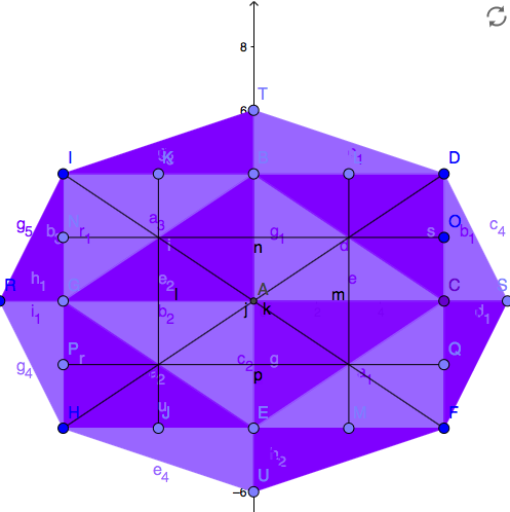
This GeoGebra example demonstrates the construction of a series of scalene triangles using intersection points, polygons, and segments. It illustrates how multiple triangles can be built sequentially from shared vertices and edges, forming a complex geometric figure. Core mathematical concepts include triangle classification (scalene), polygon area, and fundamental geometric constructions. The construction uses commands such as Intersect to find points, Point to define vertices, Polygon to create triangular faces, and Segment to draw edges. The object list includes vertices A through I and polygons poly1 through poly8, showing a layered construction process. This is suitable for middle or high school geometry lessons, helping students understand triangle properties, area relationships, and practical use of dynamic geometry software.
GeoGebra Commands & Parameters
Intersect(xAxis, yAxis) → APoint(yAxis) → BPoint(xAxis) → CPolygon(A, B, C) → poly1, c, a, bPolygon(B, C, D) → poly2, d, b_1, c_1Point(yAxis) → EPolygon(A, E, C) → poly3, c_2, a_1, ePolygon(E, C, F) → poly4, f, e_1, c_3Point(xAxis) → GPolygon(E, A, G) → poly5, g, e_2, a_2Polygon(G, A, B) → poly6, b_2, g_1, a_3Polygon(G, E, H) → poly7, h, g_2, e_3Polygon(G, B, I) → poly8, i, g_3, b_3Segment(I, F) → jSegment(H, D) → kPoint(g_2) → JPoint(g_3) → KSegment(J, K) → lPoint(c_1) → LPoint(c_3) → MSegment(L, M) → mPoint(b_3) → NSegment(N, O) → nPoint(e_3) → PPoint(e_1) → QSegment(P, Q) → pPolygon(G, R, H) → poly9, h_1, g_4, rPolygon(G, I, R) → poly10, r_1, g_5, i_1Point(xAxis) → SPolygon(C, S, D) → poly11, d_1, c_4, sPolygon(F, C, S) → poly12, s_1, f_1, c_5Point(yAxis) → TPolygon(I, T, B) → poly13, b_4, i_2, tPolygon(B, T, D) → poly14, d_2, b_5, t_1Point(yAxis) → UPolygon(H, U, E) → poly15, e_4, h_2, uPolygon(U, E, F) → poly16, f_2, u_1, e_5