
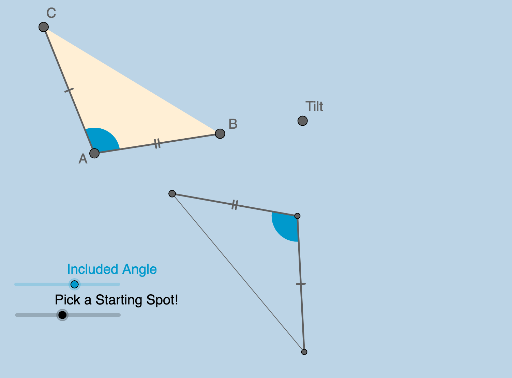
SAS Triangle Congruence Exercise by Tim Brzezinski
Loading the math board and drawing, please wait…
In collections
Congruence (CO) Cluster
Congruence (Vol 1)
Congruence (Vol 1) Over 80 Resources
Geometry (Congruence) Volume 1
CCSS High School: Geometry (Congruence) Volume 1 S N ATTAR
CCSS High School: Geometry (Congruence) Volume 1
CCSS High School: Geometry (Congruence) Volume 1
CCSS High School: Geometry (Congruence) Volume 1
CCSS High School: Geometry (Congruence) Volume 1
CCSS High School: Geometry (Congruence) Volume 1
CCSS High School: Geometry (Congruence) Volume 1
CCSS High School: Geometry (Congruence) Volume 1
CCSS High School: Geometry (Congruence) Volume 1
CCSS High School: Geometry (Congruence) Volume 1
CCSS High School: Geometry (Congruence) Volume 1
CCSS High School: Geometry (Congruence) Volume 1
Unit 5: Triangle Congruence
Triangle Congruence Theorems 1
Triangle Congruence Book 1
Proving Triangles Congruent
This example demonstrates how to prove triangle congruence using the SAS (Side-Angle-Side) Theorem. By constructing two triangles with the same two side lengths and included angle, and applying rotational and translational transformations, it visually illustrates the conditions for triangle congruence. The core mathematical concepts involved include triangle congruence, the SAS theorem, and geometric transformations. Key construction steps involve using GeoGebra commands and objects such as Ray, Rotate, Angle, Point, Polygon, Segment, Circle, Intersect, CircleSector, Vector, and Translate. Suitable for high school students learning geometric proofs and transformational geometry.
GeoGebra Commands & Parameters
Ray(A, B_1) → fRotate(B_1, α, A) → B'Angle(B_1, A, B') → βPoint(f) → BRay(A, B') → gPoint(g) → CPolygon(A, B, C) → poly1, h, i, jSegment(A, C) → kSegment(A, B) → lCircle(A, (0.2 * Min[k, l])) → cIntersect(c, f) → F,Intersect(c, k) → G,CircleSector(A, F, G) → dPoint(xAxis) → HVector(H, I) → uTranslate(A, u) → A'Translate(C, u) → D'Segment(A', D') → k'Translate(A, u) → A'_1Translate(B, u) → C'Translate(C, u) → D'_1Polygon(A'_1, C', D'_1) → poly1', d'_1, a'_1, c'Segment(D'_1, A'_1) → mSegment(C', A'_1) → nSegment(D'_1, C') → pCircle(A'_1, Radius[c]) → eIntersect(e, n, 1) → JIntersect(e, m, 1) → KCircleSector(A'_1, J, K) → qRotate(A, γ, L) → A'_2Rotate(B, γ, L) → C'_1Rotate(C, γ, L) → D'_2Polygon(A'_2, C'_1, D'_2) → poly1'_1, d'_2, a'_2, c'_1Segment(C'_1, A'_2) → rSegment(A'_2, D'_2) → sSegment(C'_1, D'_2) → tRotate(d, γ, L) → d'Vector(A'_2, D) → vTranslate(A'_2, v) → MTranslate(C'_1, v) → NTranslate(D'_2, v) → OPolygon(M, N, O) → poly2, o, m_1, n_1Translate(d', v) → d''Segment(N, M) → aSegment(M, O) → bSegment(N, O) → f_1
AI Drawing Prompt Reference
Construct two triangles with the same two sides and included angle. Start by drawing a ray from point A, then rotate point A to create point B'. Draw angle β. On the ray, take point B and draw ray g, then take point C on ray g. Form the first triangle ABC. Next, draw a circle centered at A, find the intersection points F and G with ray f and line segment BC, and draw sector AFG. Then, translate points A and C to A' and D', forming the second triangle A'CD'. Finally, rotate triangles ABC and A'CD' and translate to form the third triangle A''C'D'', ensuring all triangles meet the SAS condition.
The prompt above was compiled from the original drawing commands and is for reference only.