
SAS Similar Triangles Dynamic Demonstration by Jessica Schumacher
Loading the math board and drawing, please wait…
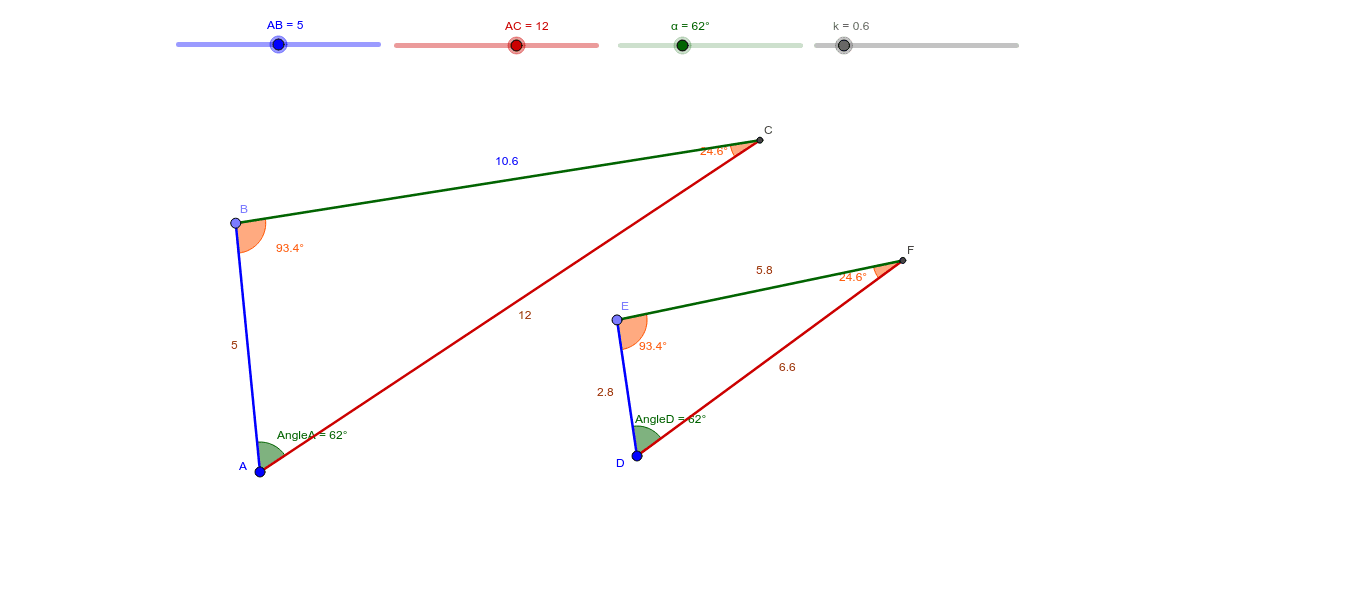
①This GeoGebra example dynamically demonstrates the SAS (Side-Angle-Side) similarity criterion for triangles, showing that if two sides are proportional and the included angle is equal, the triangles remain similar as vertices are dragged. ②Core mathematical concepts include triangle similarity, proportional sides, equal included angles, similarity ratio, and related elements such as vectors and circumcircles. ③Construction uses GeoGebra commands: Circle, Point, Rotate, Angle, Line, Intersect, Polygon, Segment; objects include points A, B, C, D, E, F, angles α, β, γ, δ, ε, ζ, polygons poly1 and poly2, and segments a, b, c, d, e, f, etc. The construction ensures the included angles are equal via rotation and angle marking, and side ratios are maintained through proportional segment lengths. ④Suitable for middle school geometry lessons or high school review, this interactive tool helps students grasp the SAS similarity condition and can be used by teachers for classroom demonstrations or by students for self-exploration.
GeoGebra Commands & Parameters
Circle(A, AB) → cCircle(A, AC) → dPoint(c) → BRotate(B, (-α), A) → B'Angle(B', A, B) → AngleALine(A, B) → aLine(A, B') → bIntersect(d, b, 2) → CPolygon(B, A, C) → poly1, c_1, b_1, a_1Angle(A, B, C) → γAngle(B, C, A) → δCircle(D, (AB * k)) → eCircle(D, (AC * k)) → fPoint(e) → ERotate(E, (-α), D) → E'Angle(E', D, E) → AngleDLine(D, E) → gLine(D, E') → hIntersect(f, h, 2) → FPolygon(E, D, F) → poly2, f_1, e_1, d_1Angle(D, E, F) → βAngle(B, C, A) → εAngle(E, F, D) → ζSegment(A, B) → iSegment(D, E) → jSegment(A, C) → lSegment(D, F) → mSegment(C, B) → nSegment(F, E) → p
AI Drawing Prompt Reference
Draw two similar triangles, ABC and DEF. First, draw circles with A as the center and AB, AC as radii to determine points B and D. Then, use rotation and angle marking to ensure that angle BAC equals angle EDF. Next, maintain the proportional relationship between sides AB and DE, AC and DF to construct triangle DEF. Finally, connect the points to form triangles ABC and DEF, demonstrating the SAS similarity condition.
The prompt above was compiled from the original drawing commands and is for reference only.