
Pythagorean Inequalities Theorem
Loading the math board and drawing, please wait…
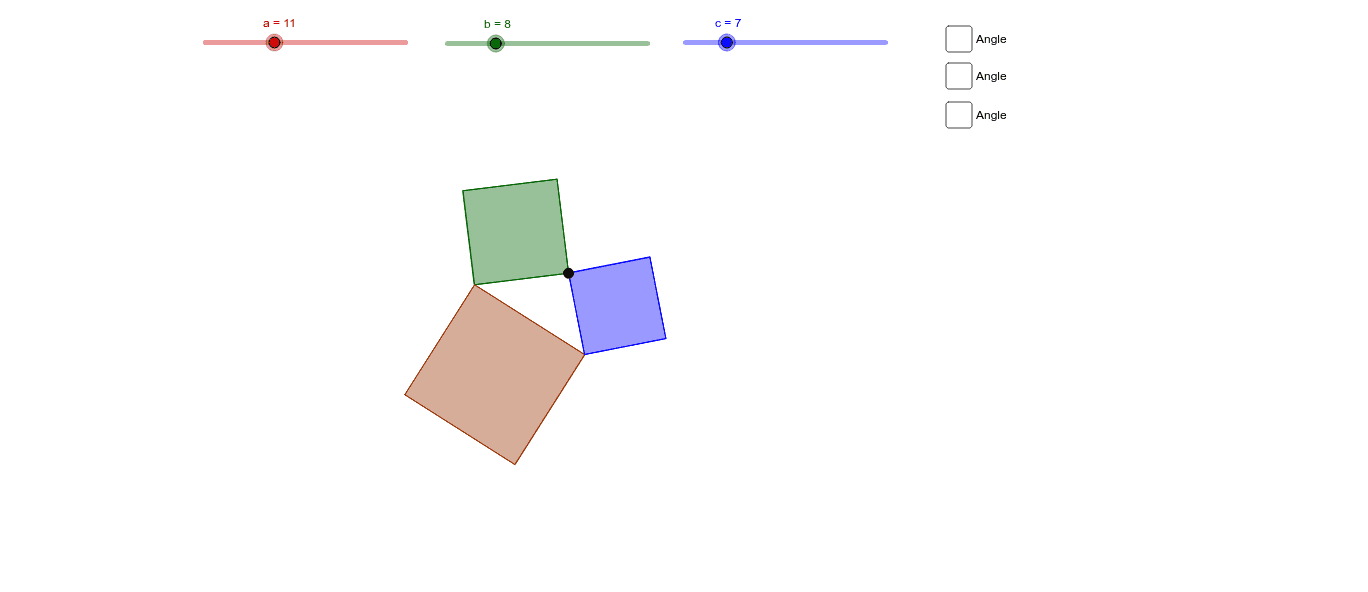
This example illustrates the Pythagorean inequalities theorem, which states that in any triangle, the square of the longest side is less than the sum of the squares of the other two sides. Key mathematical concepts include triangles, inequalities, and geometric construction. Using GeoGebra commands such as Point, Segment, Circle, and Intersect, the relationship between the sides of a triangle can be dynamically demonstrated. Suitable for middle school and above students to learn about geometric inequalities.
GeoGebra Commands & Parameters
Point(Circle[K, b]) → LSegment(K, L) → tCircle(K, a) → c_1Point(c_1) → MCircle(L, c) → f_1Intersect(c_1, f_1, 2) → NSegment(K, N) → g_1Segment(N, L) → h_1Polygon(K, L, 4) → poly1, a_1, b_1, c_2, d, A, BPolygon(N, K, 4) → poly2, e, f, g, h, C, DPolygon(L, N, 4) → poly3, k, l, m, p, E, FAngle(K, L, N) → αAngle(L, N, K) → βAngle(N, K, L) → γTextfield(α) → InputBox1
AI Drawing Prompt Reference
Draw a triangle with a base and two sides meeting at an apex above the base. From one endpoint of the base, draw a circle with radius equal to the distance from that endpoint to the apex; from the other endpoint, draw another circle with radius equal to the distance from that endpoint to the apex. The two circles intersect near the apex. Inside the triangle, draw segments from the apex to both base endpoints, creating three smaller triangular regions. Label the three interior angles at the base endpoints and the apex, and include an input box for adjusting one angle dynamically. The figure illustrates the inequality relationship among the squares of the triangle's side lengths.
The prompt above was compiled from the original drawing commands and is for reference only.