
Same-Side-Interior Angles Investigation
Loading the math board and drawing, please wait…
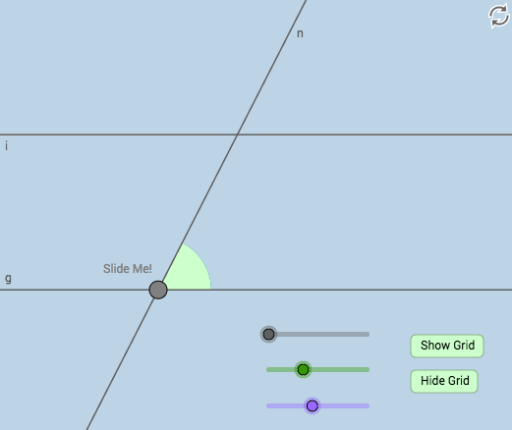
This example demonstrates the relationship between same-side interior angles formed when a transversal intersects parallel lines. Key math concepts include properties of parallel lines, the same-side interior angle theorem, and angle measurement. It utilizes GeoGebra commands and objects such as points, lines, rotation, angles, circles, intersections, segments, sectors, vectors, translation, rays, and arcs. Suitable for middle school and above mathematics education to visually understand the connection between parallel lines and angles.
GeoGebra Commands & Parameters
Point(y = 0) → ALine(A, B) → fRotate(B, α, A) → B'Angle(B, A, B') → γLine(A, B') → gRotate(B', β, A) → B''Angle(B', A, B'') → δLine(A, B'') → hCircle(A, a) → cIntersect(c, h, 2) → CLine(C, g) → iCircle(C, A) → dCircle(A, C) → eIntersect(e, h, 2) → JSegment(A, C) → jCircle(A, (0.3 * j)) → kCircle(C, (0.3 * j)) → pIntersect(p, h) → N, OIntersect(k, h) → P, QIntersect(k, g) → T, UIntersect(p, i, 2) → VIntersect(p, i, 1) → WCircleSector(A, U, Q) → qCircle(C, j / 2) → g_1Circle(A, j / 2) → h_1Intersect(g_1, i, 2) → DIntersect(g_1, i, 1) → EIntersect(g_1, h, 2) → HIntersect(g_1, h) → I, ZIntersect(h_1, h) → A_1, B_1Intersect(h_1, g) → E_1, F_1Point(j) → G_1Vector(A, G_1) → uTranslate(q, u) → q'Segment(A, G_1) → lRay(A, A_1) → mRay(C, H) → nVector(A, G_1) → vSegment(G_1, C) → sCircleArc(A, U, Q) → tCircleArc(C, N, O) → rPoint(r) → FRotate(F, (-δ), C) → F'Angle(F', C, F) → εSegment(A, C) → bCircleSector(C, N, V) → d_1
AI Drawing Prompt Reference
Draw two parallel lines intersected by a transversal. Measure and display the same-side interior angles formed, showing they are equal. Construct auxiliary segments using circles and intersections, labeling key angles. Rotate and reflect parts of the figure to observe angle relationships. Use arcs and sectors to emphasize angle sizes, completing the geometric construction demonstration.
The prompt above was compiled from the original drawing commands and is for reference only.