
Rotations on the Cartesian Plane
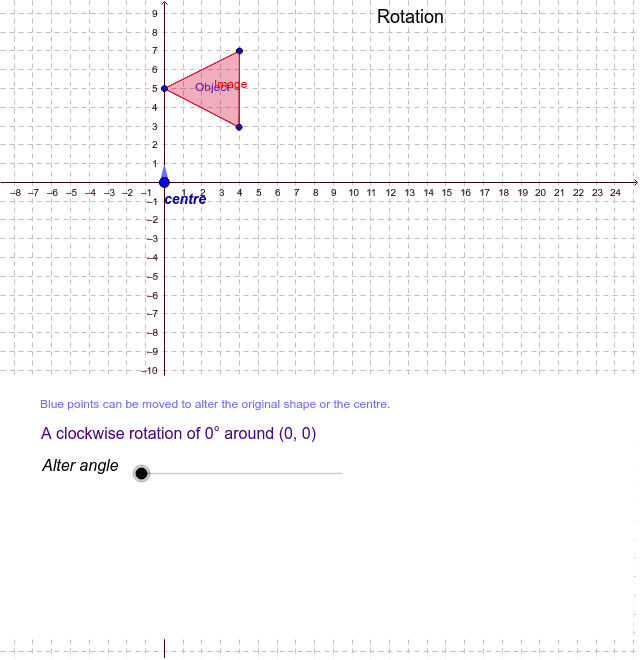
Loading the math board and drawing, please wait…
This example demonstrates the process and effects of rotating polygons on the Cartesian plane. Core math concepts include transformation, coordinate geometry, vectors, and angles. It utilizes commands/objects like Polygon, Dilate, Ray, Translate, Vector, Rotate, Line, Mirror, Angle, and Point in GeoGebra. Suitable for high school students learning geometric transformations and their coordinate representations, as well as parametric equations.
GeoGebra Commands & Parameters
Polygon(C, D, B) → poly1, b, c, dDilate(C, a, A) → C'_1Dilate(D, a, A) → D'_1Dilate(B, a, A) → B'_1Polygon(C'_1, D'_1, B'_1) → poly1'_1, b', c', d'Ray(A, C) → eRay(A, B) → fRay(A, D) → gTranslate(C, Vector[(horz, vert)]) → C'_2Translate(D, Vector[(horz, vert)]) → D'_2Translate(B, Vector[(horz, vert)]) → B'_2Polygon(C'_2, D'_2, B'_2) → poly1'_2, b'_1, c'_1, d'_1Vector(C, C'_2) → uVector(B, B'_2) → vVector(D, D'_2) → wRotate(C, (-α), A) → C'_3Rotate(D, (-α), A) → D'_3Rotate(B, (-α), A) → B'_3Polygon(C'_3, D'_3, B'_3) → poly1'_3, b'_2, c'_2, d'_2Line(F, E) → hMirror(C, h) → C'Mirror(D, h) → D'Mirror(B, h) → B'Polygon(C', D', B') → poly1', b'_3, c'_3, d'_3Vector(A, G) → zAngle(G, A, H) → βPolygon(I, J, K, L) → poly2, i, j, k_1, lPoint(j) → PPolygon(M, N, O, P) → poly3, m, n, o, p