
Rotational Symmetry of Quadrilaterals by azb
Loading the math board and drawing, please wait…
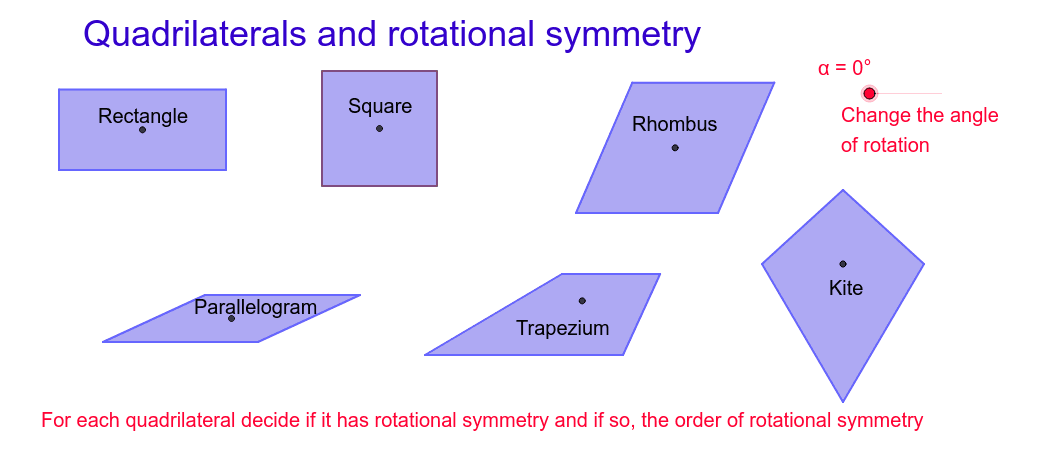
This example demonstrates the rotational symmetry of quadrilaterals. Key mathematical concepts include rotational symmetry and geometric transformations. Using GeoGebra commands such as Segment, OrthogonalLine, Point, Intersect, Polygon, Circle, Line, Rotate, Mirror, etc., a quadrilateral with rotational symmetry can be constructed. Suitable for middle school and above students to learn about geometric transformations and symmetry.
GeoGebra Commands & Parameters
Segment(A, B) → aOrthogonalLine(A, a) → bOrthogonalLine(B, a) → cPoint(b) → COrthogonalLine(C, b) → dIntersect(c, d) → DPolygon(C, D, B, A) → poly1, c_1, d_1, b_1, a_1Segment(C, B) → eSegment(D, A) → fIntersect(e, f) → EPolygon(F, G, 4) → poly2, f_1, g, h, i, H, ISegment(I, G) → jSegment(H, F) → kIntersect(j, k) → JSegment(K, L) → lCircle(K, L) → pPoint(p) → MSegment(K, M) → mLine(M, l) → nLine(L, m) → qIntersect(n, q) → NSegment(M, L) → rSegment(N, K) → sIntersect(r, s) → OPolygon(M, N, L, K) → poly3, m_1, n_1, l_1, k_1Rotate(C, (-α), E) → C'Rotate(D, (-α), E) → D'Rotate(B, (-α), E) → B'Rotate(A, (-α), E) → A'Polygon(C', D', B', A') → poly1', c', d', b', a'Rotate(M, (-α), O) → M'Rotate(N, (-α), O) → N'Rotate(L, (-α), O) → L'Rotate(K, (-α), O) → K'Polygon(M', N', L', K') → poly3', m', n', l', k'Segment(P, Q) → tSegment(P, R) → e_1Line(Q, e_1) → g_1Line(R, t) → h_1Intersect(g_1, h_1) → SPolygon(P, R, S, Q) → poly4, p_1, r_1, s_1, q_1Segment(R, Q) → i_1Segment(S, P) → j_1Intersect(i_1, j_1) → TRotate(P, (-α), T) → P'Rotate(R, (-α), T) → R'Rotate(S, (-α), T) → S'Rotate(Q, (-α), T) → Q'Polygon(P', R', S', Q') → poly4', p', r', s', q'Segment(U, V) → t_1Segment(U, W) → a_2Line(W, t_1) → b_2Point(b_2) → ZSegment(Z, V) → c_2Polygon(U, V, Z, W) → poly5, u, v, z, wSegment(W, V) → d_2Segment(Z, U) → e_2Intersect(d_2, e_2) → A_1Rotate(U, (-α), A_1) → U'Rotate(V, (-α), A_1) → V'Rotate(Z, (-α), A_1) → Z'Rotate(W, (-α), A_1) → W'Polygon(U', V', Z', W') → poly5', u', v', z', w'Line(B_1, C_1) → f_2Mirror(D_1, f_2) → E_1Polygon(D_1, B_1, E_1, C_1) → poly6, d_3, b_3, e_3, c_3Segment(D_1, E_1) → g_2Intersect(f_2, g_2) → F_1Rotate(D_1, (-α), F_1) → G_1Rotate(B_1, (-α), F_1) → H_1Rotate(E_1, (-α), F_1) → I_1Rotate(C_1, (-α), F_1) → J_1Polygon(G_1, H_1, I_1, J_1) → poly6', g_3, h_2, i_2, j_2Rotate(poly2, (-α), J) → poly2'
AI Drawing Prompt Reference
Draw a quadrilateral and demonstrate its rotational symmetry. First, construct an arbitrary quadrilateral, then rotate it by a fixed angle (e.g., negative alpha) about the intersection point of its diagonals, showing the rotated copy in a different color or dashed style. Next, construct another quadrilateral, rotate it similarly about its diagonal intersection, and display the symmetry. Finally, create a quadrilateral formed by two segments and two rays, rotate it about its diagonal intersection as well, resulting in overlapping symmetric shapes. All rotated copies should align with or partially overlap the originals, illustrating rotational symmetry.
The prompt above was compiled from the original drawing commands and is for reference only.