
Rotating Polygons by John Golden
Loading the math board and drawing, please wait…
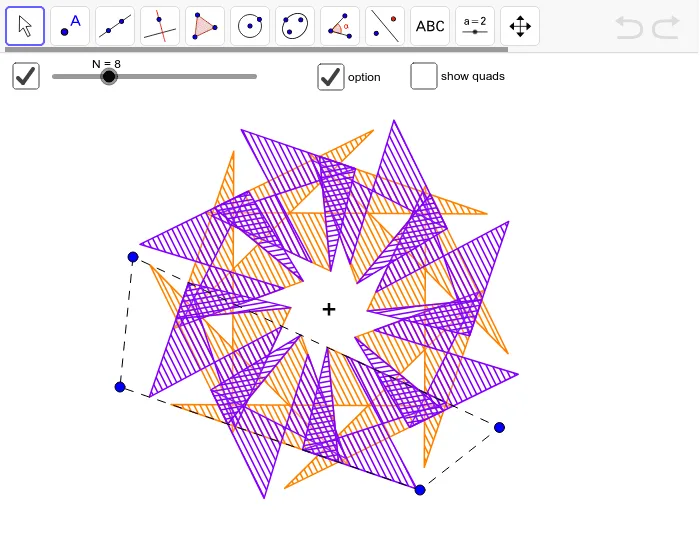
This example demonstrates the process of constructing complex polygons by rotating a quadrilateral and using its intersections with itself. It involves core mathematical concepts such as rotation, symmetry, polygon construction, and intersection calculation. Key GeoGebra commands/objects used include Polygon, Rotate, Intersect, Sequence, PolyLine, and Rotgon, as outlined in the construction summary. It is suitable for high school and above students to understand transformation geometry and complex figure construction.
GeoGebra Commands & Parameters
Polygon(A, B, C, D) → poly1, a, b, c, dRotate(A, (360 * ° / N), E) → A'Rotate(B, (360 * ° / N), E) → B'Rotate(C, (360 * ° / N), E) → C'Rotate(D, (360 * ° / N), E) → D'Polygon(A', B', C', D') → poly1', a', b', c', d'Intersect(poly1, poly1') → F, G, F_1, F_2, F_3, F_4, F_5, F_6, F_7, F_8Polygon({Intersect[poly1, poly1']}) → poly2Polygon(F_1, D, C) → poly3, c_1, f_1, d_1Polygon(F_2, A, G) → poly4, g, f_2, a_1Polygon(F, C, B) → poly5, b_1, f, c_2Sequence(Rotate[poly2, ((i * 360) * ° / N), E], i, 1, N) → list1Sequence(Polygon[Rotate[F_1, ((i * 360) * ° / N), E], Rotate[D, ((i * 360) * ° / N), E], Rotate[C, ((i * 360) * ° / N), E]], i, 1, N) → list2Sequence(Polygon[Rotate[F_2, ((i * 360) * ° / N), E], Rotate[A, ((i * 360) * ° / N), E], Rotate[G, ((i * 360) * ° / N), E]], i, 1, N) → list3Sequence(Polygon[Rotate[F, ((i * 360) * ° / N), E], Rotate[C, ((i * 360) * ° / N), E], Rotate[B, ((i * 360) * ° / N), E]], i, 1, N) → list4Sequence(Polygon[Rotate[A, ((i * 360) * ° / N), E], Rotate[B, ((i * 360) * ° / N), E], Rotate[C, ((i * 360) * ° / N), E], Rotate[D, ((i * 360) * ° / N), E]], i, 1, N) → list5Polygon(F_2, F_3, F_4) → poly6, f_4, f_3, f_5Sequence(Polygon[Rotate[F_2, ((i * 360) * ° / N), E], Rotate[F_3, ((i * 360) * ° / N), E], Rotate[F_4, ((i * 360) * ° / N), E]], i, 1, N) → list6PolyLine(A, B, C, D, A) → hRotate(A', (360 * ° / N), E) → A''Rotate(B', (360 * ° / N), E) → B''Rotate(C', (360 * ° / N), E) → C''Rotate(D', (360 * ° / N), E) → D''Polygon(A'', B'', C'', D'') → poly1'', a'', b'', c'', d''Intersect(poly1'', poly1) → H, I, H_1, H_2, H_3, H_4, H_5, H_6, H_7, H_8Polygon(H, I, D) → poly7, i, j, kPolygon({Intersect[poly1, poly1'']}) → poly9Sequence(Rotate[poly9, ((i * 360) * ° / N), E], i, 1, N) → list8Polygon(F, H, B) → poly8, b_2, f_6, h_1Sequence(Polygon[Rotate[F, ((i * 360) * ° / N), E], Rotate[H, ((i * 360) * ° / N), E], Rotate[B, ((i * 360) * ° / N), E]], i, 1, N) → list9Polygon(G, H, D) → poly10, d_2, g_1, h_2Sequence(Polygon[Rotate[G, ((i * 360) * ° / N), E], Rotate[H, ((i * 360) * ° / N), E], Rotate[D, ((i * 360) * ° / N), E]], i, 1, N) → list10Sequence(Polygon[Rotate[H, ((i * 360) * ° / N), E], Rotate[I, ((i * 360) * ° / N), E], Rotate[B, ((i * 360) * ° / N), E]], i, 1, N) → list7Rotgon(E, N, F, F_2, H_1) → list11