
Roots of an Absolute Value Equation
Loading the math board and drawing, please wait…
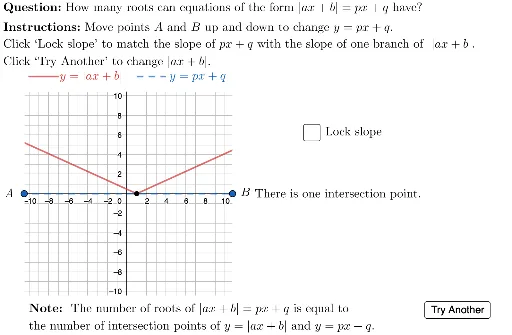
This example demonstrates the geometric representation and solution process of the roots of an absolute value equation. Key math concepts include absolute value functions, equation solving, and geometric constructions. It utilizes GeoGebra commands like Ray, Slope, Mirror, Intersect, Segment, Point, Line, RemoveUndefined, Element, If, Polygon, Unique, and LaTeX for construction. Suitable for high school mathematics students to understand the solution methods and geometric significance of absolute value equations.
GeoGebra Commands & Parameters
Ray(C, C') → RayC'Slope(RayC') → minSlopeMirror(C', x = x(C)) → C''Ray(C, C'') → RayC''Intersect(RayC'', Line[topRight, yAxis]) → maxRightSlope(RayC'') → maxSlopeSegment((vbRight, vbBottom), (vbRight, vbTop)) → vSliderRightPoint(vSliderRight) → BIntersect(RayC', Line[bottomLeft, yAxis]) → maxLeftSegment((vbLeft, vbBottom), (vbLeft, vbTop)) → vSliderLeftPoint(vSliderLeft) → ALine(B, A) → LineARemoveUndefined(Union[{Intersect[LineA, RayC']}, {Intersect[LineA, RayC'']}]) → IntersectionPointsAElement(IntersectionPointsA, 1) → firstIntPtIf(xInterceptVal > 0, Line[B, Line[C, C']], Line[A, Line[C, C'']]) → LineBRemoveUndefined(Union[{Intersect[LineB, RayC']}, {Intersect[LineB, RayC'']}]) → IntersectionPointsBPolygon({(vbRight, vbTop), (vbRight, vbBottom), (vbLeft, vbBottom), (vbLeft, vbTop)}) → viewboxRemoveUndefined(Zip[If[IsInRegion[A, viewbox], A], A, IntersectionPointsB]) → IntPointsBInViewboxIf(fixedSlope, Slope[LineB] ≟ maxSlope ∧ Distance[Element[IntersectionPointsB, 1], C] < pointTolerance, Distance[B, maxRight] < pointTolerance ∧ abs(Slope[LineA] - maxSlope) < slopeTolerance) → infiniteSolutionsC''If(fixedSlope, Distance[Element[IntersectionPointsB, 1], C] < pointTolerance ∧ Slope[LineB] ≟ minSlope, Distance[maxLeft, A] < pointTolerance ∧ abs(Slope[LineA] - minSlope) < slopeTolerance) → infiniteSolutionsC'Unique(Zip[If[Distance[A, firstIntPt] < pointTolerance, firstIntPt, A], A, IntersectionPointsA]) → IntPtsWithToleranceARemoveUndefined(Zip[If[IsInRegion[A, viewbox], A], A, IntPtsWithToleranceA]) → IntPointsInViewboxLaTeX("y=\left\vert ax+b \right\vert") → lblFIf(fixedSlope, If[Defined[IntersectionPointsB], Length[IntersectionPointsB], 0], If[Defined[IntPtsWithToleranceA], Length[IntPtsWithToleranceA], 0]) → numIntersectionPointsLaTeX("y=px+q") → lblGIntersect(If[fixedSlope, LineB, LineA], x = 3) → LblptLaTeX("\text{\textbf{Instructions: }Move points \(A\) and \(B\) up and down to change \(y=px+q\).\\Click `Lock slope' to match the slope of \(px+q\) with the slope of one branch of \(\left\vert ax+b\right\vert\). \\Click `Try Another' to change \(\left\vert ax+b \right\vert\).}") → SpecInstrucLaTeX("\text{\textbf{Note: } The number of roots of \(\left\vert ax+b\right\vert = px+q\) is equal to\\the number of intersection points of \(y=\left\vert ax + b \right\vert \) and \(y=px + q\).}") → txtInfoRay(C, C'') → RayC''InfiniteLaTeX(If[nonVisiblePoints, "Note: one or more of the intersection \\points is not visible in the viewing window.", ""]) → fbNotVisibleRay(C, C') → RayC'InfiniteLaTeX((((("\text{There " * If[infiniteSolutions, "are an infinite number \\of intersection points.", If[numIntersectionPoints ≟ 0, "are NO intersection points.", If[numIntersectionPoints ≟ 1, "is one intersection point.", "are two intersection points."]]]) * "\\") * fbNotVisible) * "}")) → txtNumIntersectionPtsLaTeX("\text{\textbf{Question: }How many roots can equations of the form \(\left\vert ax+b \right\vert = px+q\) have?}") → MainInstrucSegment(Element[legendAnchors, 2], Element[legendAnchors, 2] + (3, 0)) → lineLegendSegment(Element[legendAnchors, 1], Element[legendAnchors, 1] + (3, 0)) → fxLegend