
Root Shifting: Dynamic Demonstration of Function Roots Moving with Parameters
Loading the math board and drawing, please wait…
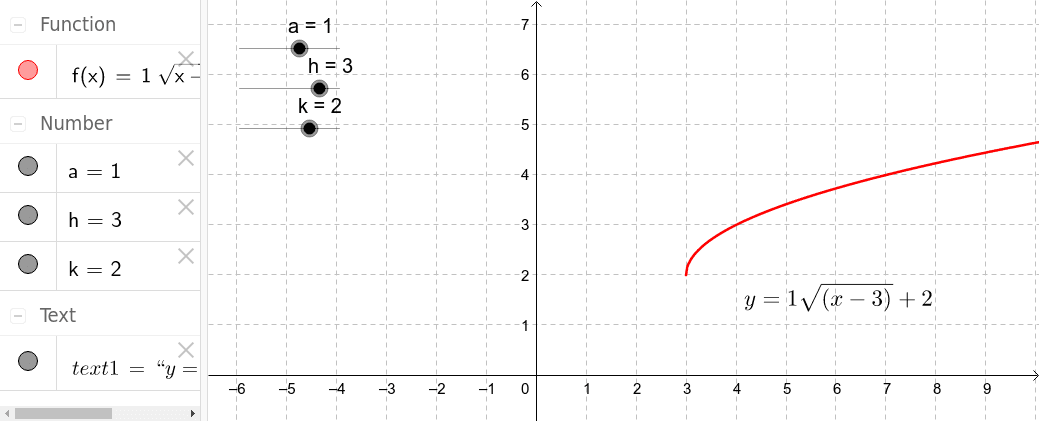
① This GeoGebra example dynamically shows how the roots (zeros) of a function shift as parameters change, visually illustrating the effect of horizontal and vertical translations on the positions of roots. ② Core mathematical concepts include function zeros, graph transformations (translation), parameter control, and the relationship between coefficients and roots, typically for quadratic or general functions. ③ Construction details: The objects used are a, h, k, f, and text1, where a, h, k are adjustable parameters (sliders), f is the function expression, and text1 displays the current root positions or explanatory text; by changing h and k, the entire graph translates, and the roots move accordingly, demonstrating the concept of 'root shifting'. ④ Suitable for middle and high school mathematics (grades 8-12) when learning function transformations and zeros, and useful for classroom demonstrations or student self-exploration of how parameters affect graphs.
GeoGebra Commands & Parameters
Numeric a(1.0)Numeric h(3.0)Numeric k(2.0)f(x) = a * sqrt(x - h) + k
AI Drawing Prompt Reference
Create a dynamic graph demonstrating how function roots shift with parameter changes. Include three adjustable sliders: one for vertical stretch, one for horizontal translation, and one for vertical translation. The function is a square root function whose graph translates as the horizontal and vertical sliders change, causing the root to move accordingly. Display the curve, coordinate axes, and a text box showing the current root position or explanatory text. Drag the sliders to observe the relationship between graph translation and root movement, illustrating the effect of transformations on zeros.
The prompt above was compiled from the original drawing commands and is for reference only.