
Root-Mean-Squared Current
Loading the math board and drawing, please wait…
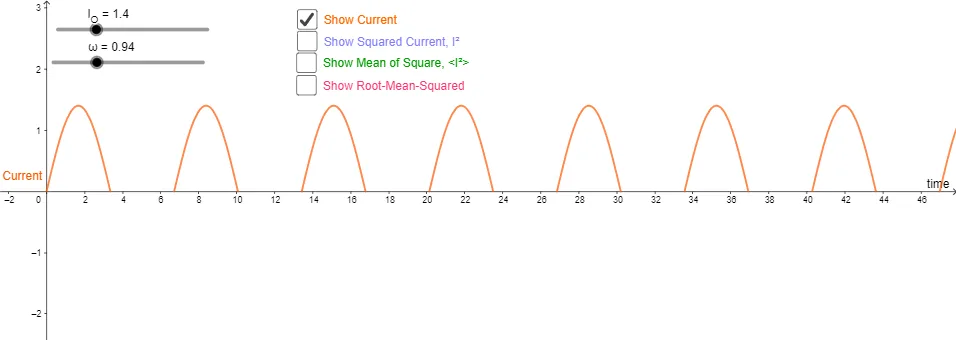
This example illustrates the concept of Root-Mean-Squared (RMS) current. It involves calculating the square average of current, which is a crucial concept in circuit analysis. Using GeoGebra objects such as omega, T, I_O, f, g, b, c_1, a, h, p, t, c, d, e, i, it provides a visual representation of the RMS value of a current waveform. Suitable for high school physics and electrical engineering courses.
GeoGebra Commands & Parameters
Numeric omega(0.936)(2 * π / omega)Numeric I_O(1.4)f(x) = If[x ≥ 0 ∧ sin((omega * x)) ≥ 0, (I_O * sin((omega * x)))]g(x) = f(x)^(2)Boolean b(false)Numeric c_1(0)Integral[g, 0, (2 * π)] / ((2 * π))h(x) = Integral[g(x), 0, (0.5 * T)] / Tp(x) = sqrt(h(x))0Boolean c(true)Boolean d(false)Boolean e(false)Boolean i(false)
AI Drawing Prompt Reference
Draw a graph illustrating the concept of RMS current, featuring a sine wave current, square the wave, integrate the squared wave over half a period and divide by the period to get the average, then take the square root of the average to obtain the RMS current value, using different colors or line styles to distinguish the wave, squared wave, integral area, and RMS value.
The prompt above was compiled from the original drawing commands and is for reference only.