
Right Triangular Prism: Construction and Volume/Surface Area Exploration
Loading the math board and drawing, please wait…
In collections
Area, Surface Area, Volume--Nets
Area, perimeter and volume of shapes
Area, Perimeter and Volume of shapes
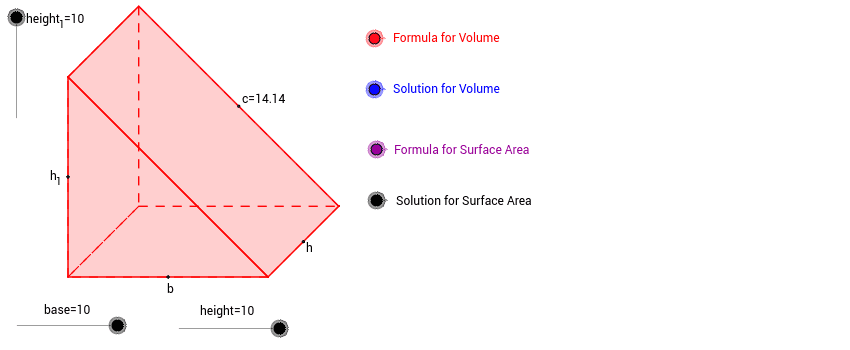
①This GeoGebra example demonstrates how to dynamically construct a right triangular prism, showing its base, height, edges, and computed volume and surface area. ②Core math concepts include the definition of a prism, a right triangular base, perpendicular lateral edges, volume formula V = base area × height, surface area calculation, and spatial transformations such as translation and dilation. ③Construction details: from the summary, commands such as Dilate, Vector, Circle, Line, Intersect, Translate, Polygon, Midpoint, and If are used to create base triangle ABC and its translated copy A'B'C', with a slider controlling the prism height, while base area, lateral area, and volume are computed. ④Suitable for middle and high school geometry lessons, especially introductory solid geometry, volume and surface area of prisms, and dynamic exploration to enhance spatial reasoning.
GeoGebra Commands & Parameters
Dilate(F, height_1, E) → GVector(E, G) → uDilate(I, base, H) → LVector(H, L) → vCircle(J, height) → gLine(J, K) → hIntersect(g, h, 1) → MVector(J, M) → wTranslate(A, v) → BTranslate(A, u) → CPolygon(C, A, B) → P, b, c, aTranslate(C, Vector[w / 2]) → C'Translate(A, Vector[w / 2]) → A'Translate(B, Vector[w / 2]) → B'Polygon(C', A', B') → P', b', c', a'Polygon(C, C', A', A) → Q, c_1, c'_1, a'_1, a_1Polygon(C, B, B', C') → R, c_2, b_1, b'_1, c'_2Polygon(A, A', B', B) → S, a_2, a'_2, b'_2, b_2Midpoint(C, A) → DMidpoint(A, B) → NMidpoint(B, B') → OMidpoint(C, A) → TMidpoint(A, B) → UMidpoint(B, B') → VIf(VolumeFormula ≟ 1, W) → B_1If(VolumeSolution ≟ 1, Y) → C_1If(SurfaceAreaFormula ≟ 1, Z) → D_1If(SurfaceAreaSolution ≟ 1, A_1) → E_1Midpoint(B', C') → F_1