
Riemann Sums - Rectangular Approximation (LRAM, RRAM, MRAM)
Loading the math board and drawing, please wait…
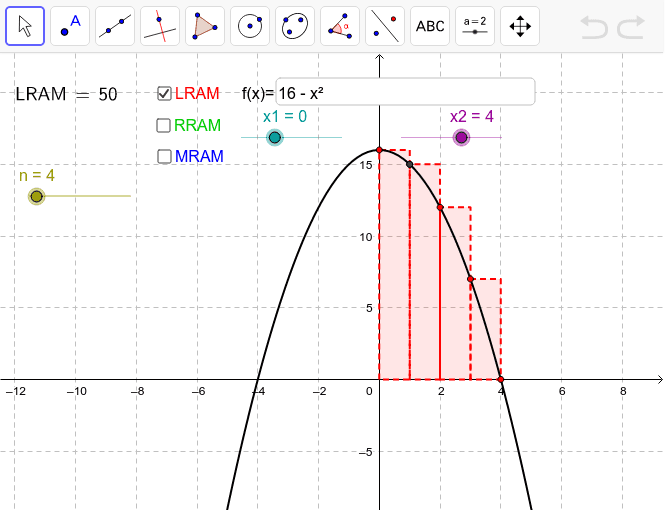
This GeoGebra example demonstrates the approximation of a definite integral using rectangular sums, with adjustable rectangle counts and bounds. It covers core concepts such as Riemann sums, definite integrals, and limit convergence. The construction utilizes GeoGebra commands including Sequence, Sum, and LaTeX text objects, along with geometric elements like functions, interval endpoints, and rectangle vertices. It is suitable for high school and early college calculus students learning integral approximation.
GeoGebra Commands & Parameters
Sequence(f(i) * h, i, x1 + h / 2, x2 - h / 2, h) → M2Sequence(f(i) * h, i, x1 + h, x2, h) → R2Sequence(f(i) * h, i, x1, x2 - h, h) → L2Sequence((i, f(i)), i, x1, x2, h) → L1Sequence(Polygon[(x(Element[L1, i]), 0), Element[L1, i], (x(Element[L1, i + 1]), y(Element[L1, i])), (x(Element[L1, i + 1]), 0)], i, 1, n) → LeftPSequence(Polygon[(x(Element[L1, i]), 0), (x(Element[L1, i]), y(Element[L1, i + 1])), Element[L1, i + 1], (x(Element[L1, i + 1]), 0)], i, 1, n) → RightPSequence((i + h / 2, f(i + h / 2)), i, x1, x2 - h, h) → LMSequence(Polygon[(x(Element[L1, i]), 0), (x(Element[L1, i]), y(Element[LM, i])), (x(Element[L1, i + 1]), y(Element[LM, i])), (x(Element[L1, i + 1]), 0)], i, 1, n) → MidPSum(L2) → LRAMSum(R2) → RRAMSum(M2) → MRAMLaTeX(LRAM, true, true) → text4LaTeX(RRAM, true, true) → text5LaTeX(MRAM, true, true) → text6Textfield(f) → inputBox1Element(L1, 2) → A