
Rhombus with Diagonals by Vinny Cousineau
Loading the math board and drawing, please wait…
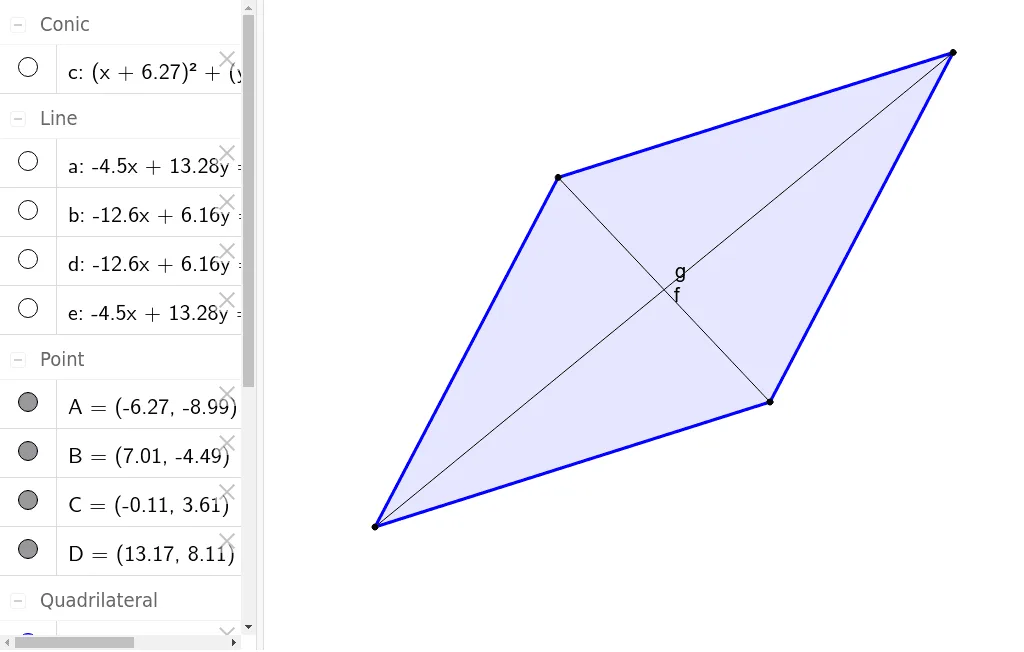
This example demonstrates the geometric properties of a rhombus, including the perpendicular bisector relationship of its diagonals and the equality of all four sides. Core mathematical concepts involve plane geometry, vectors, logical reasoning, equation solving, and analytical geometry. The construction uses GeoGebra commands such as Line, Circle, Point, Intersect, Polygon, and Segment to build the rhombus, its diagonals, intersection points, and other geometric objects. It is suitable for high school mathematics instruction, demonstrating geometric constructions and property exploration.
GeoGebra Commands & Parameters
Line(A, B) → aCircle(A, B) → cPoint(c) → CLine(A, C) → bLine(B, b) → dLine(C, a) → eIntersect(d, e) → DPolygon(A, B, D, C) → poly1, a_1, b_1, d_1, c_1Segment(A, D) → fSegment(B, C) → g
AI Drawing Prompt Reference
Draw a rhombus to demonstrate that its diagonals are perpendicular bisectors and all four sides are equal. Start by drawing two intersecting line segments. Use one segment as the diameter to draw a circle, and connect the intersection points of the circle with the other segment to the endpoints of the first segment, forming the rhombus. Then draw the diagonals and mark their intersection point. Finally, connect the four vertices of the rhombus with line segments.
The prompt above was compiled from the original drawing commands and is for reference only.