
Rhombus Edited: Dynamic Exploration of Sides, Diagonals, and Angles
Loading the math board and drawing, please wait…
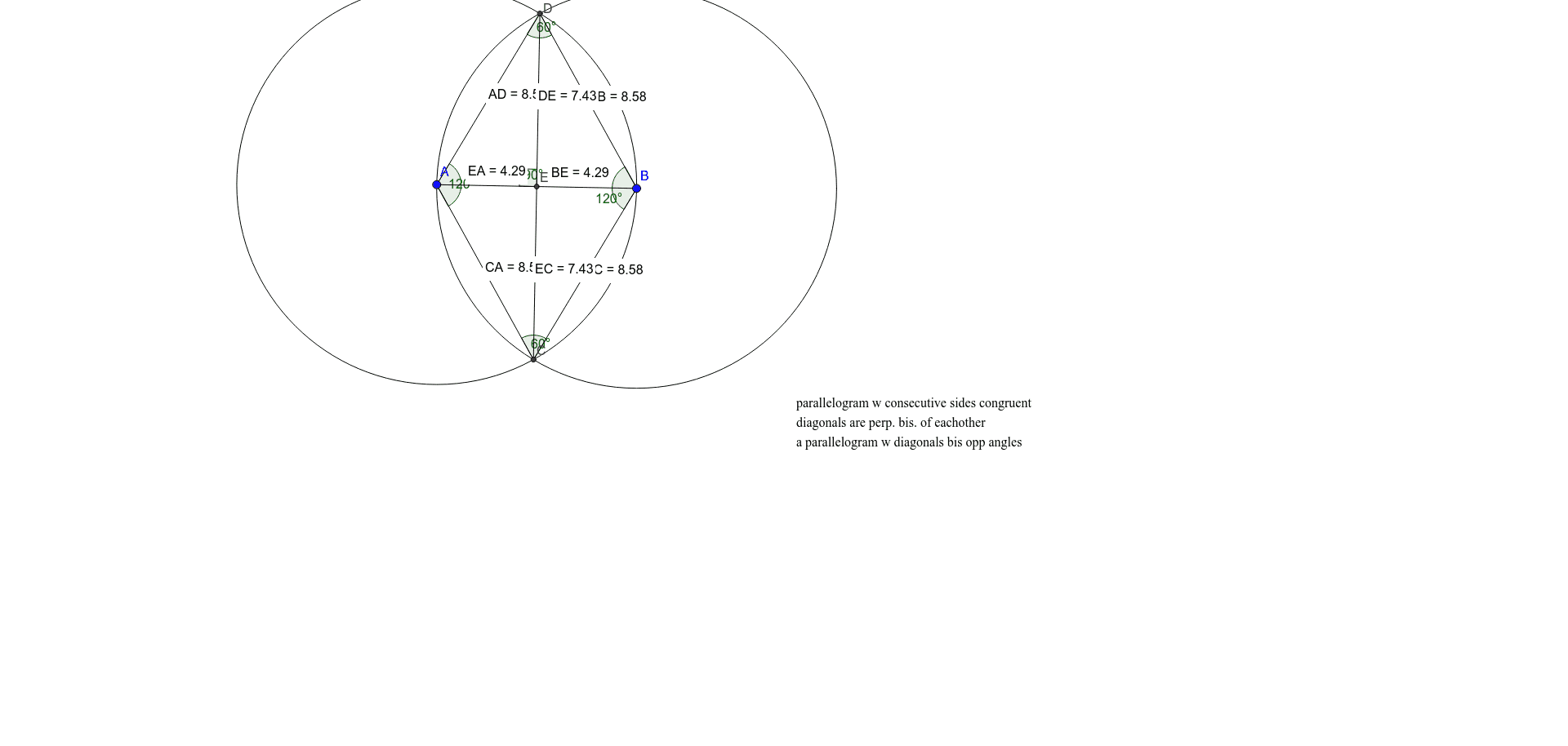
① This example demonstrates a rhombus construction and editing, allowing dynamic adjustment of vertices to visually verify properties such as equal side lengths and perpendicular bisecting diagonals. ② Core mathematical concepts include the definition of a rhombus (all sides equal), diagonal properties, angle relationships (opposite angles equal, adjacent supplementary), and distance/angle measurement. ③ Construction details: using GeoGebra commands Segment to draw sides, Circle to construct equal-length segments, Intersect to find points, Distance and Angle to measure lengths and angles; objects include points A, B, C, D, E, segments f, c, d, g, h, i, j, multiple distance texts (e.g., distanceAD, distanceDB) and angle variables (α, β, γ, δ, ε), with text labels. ④ Suitable for middle school geometry or high school analytic geometry introduction, useful for exploring rhombus properties, verifying theorems, and serving as a template for dynamic geometry lessons.
GeoGebra Commands & Parameters
Segment(A, B) → fCircle(A, B) → cCircle(B, A) → dIntersect(c, d, 2) → CIntersect(c, d, 1) → DSegment(D, A) → gSegment(A, C) → hSegment(B, C) → iSegment(B, D) → jDistance(A, D) → distanceADDistance(D, B) → distanceDBDistance(B, C) → distanceBCDistance(C, A) → distanceCAAngle(B, C, A) → αAngle(A, D, B) → βSegment(D, C) → kIntersect(f, k) → EDistance(E, A) → distanceEADistance(B, E) → distanceBEDistance(D, E) → distanceDEDistance(E, C) → distanceECAngle(C, A, D) → γAngle(D, B, C) → δAngle(D, E, A) → ε
AI Drawing Prompt Reference
Draw a dynamic rhombus. Start with a base segment, then construct two circles centered at its endpoints with radius equal to the base length. The two intersection points of these circles define the other two vertices. Connect all four vertices to form the rhombus. Draw both diagonals and mark their intersection point. Measure and display the lengths of all four sides, both diagonals, and the angles at each vertex. Also measure the two segments on each diagonal created by the intersection point. All points should be draggable so the shape updates dynamically, allowing verification that all sides are equal, diagonals are perpendicular bisectors, and opposite angles are equal.
The prompt above was compiled from the original drawing commands and is for reference only.