
G.GCO.10 Determining the Properties of a Parallelogram
Loading the math board and drawing, please wait…
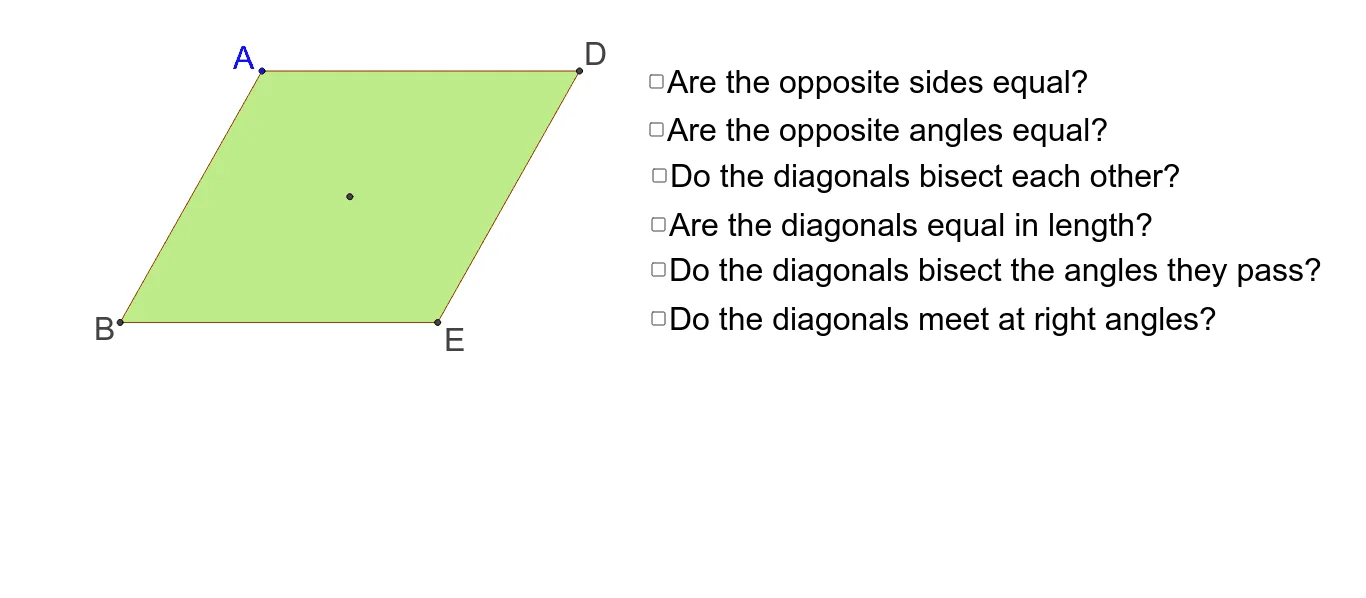
This interactive GeoGebra applet guides students to discover the fundamental properties of a parallelogram through dynamic manipulation. ① It demonstrates that opposite sides are parallel and equal, opposite angles are equal, consecutive angles are supplementary, and diagonals bisect each other, while allowing users to drag vertices to resize the shape and verify these properties remain invariant. ② Core mathematical concepts include the definition of a parallelogram, side-angle relationships, diagonal properties, and the 'conjecture-verify' process in geometric reasoning. ③ Construction highlights: the applet uses GeoGebra commands such as Intersect, Line, Point, Polygon, Segment, and Angle to create vertices A, B, C, D, diagonal intersection E, and multiple auxiliary segments and angle markers (α, β, γ, δ, etc.) to visualize the properties. ④ Suitable for middle school geometry lessons or self-study, especially for classroom inquiry activities where students can induce parallelogram properties from hands-on exploration, fostering dynamic geometry thinking and logical deduction skills.
GeoGebra Commands & Parameters
Intersect(xAxis, yAxis) → BLine(B, A) → aLine(A, xAxis) → bLine(B, b) → cPoint(c) → CLine(C, a) → dIntersect(b, d) → DIntersect(c, d) → EPolygon(B, A, D, E) → poly1, b_1, a_1, d_1, eSegment(B, D) → fSegment(A, E) → gIntersect(f, g) → FSegment(B, F) → hSegment(F, D) → iSegment(E, F) → jSegment(F, A) → kAngle(E, F, D) → αAngle(D, F, A) → βAngle(A, F, B) → γAngle(B, F, E) → δAngle(D, E, B) → εAngle(B, A, D) → ζAngle(A, D, E) → ηAngle(E, B, A) → θAngle(E, B, F) → ιAngle(F, B, A) → κAngle(B, A, F) → λAngle(F, A, D) → μAngle(F, E, B) → νAngle(D, E, F) → ξAngle(F, D, E) → οAngle(A, D, F) → ρPolygon(A, D, E, B) → poly2, a_2, d_2, e_1, b_2Segment(A, E) → pSegment(B, D) → sSegment(A, E) → rSegment(B, D) → c_1
AI Drawing Prompt Reference
Draw a parallelogram ABCD with points A, B, C, and D as vertices. Start by drawing a line through points B and A, then draw a line through B parallel to the x-axis, find point C on this line, draw a line through C parallel to the first line, and find point D at the intersection of these lines. Connect points A, D, and E, where E is the intersection of AC and BD. Draw diagonals AC and BD and mark their intersection point E. Label all angles, such as ∠α, ∠β, ∠γ, ∠δ, etc., and observe and verify the properties of the parallelogram.
The prompt above was compiled from the original drawing commands and is for reference only.