
Demonstrating Sphere Volume Formula
Loading the math board and drawing, please wait…
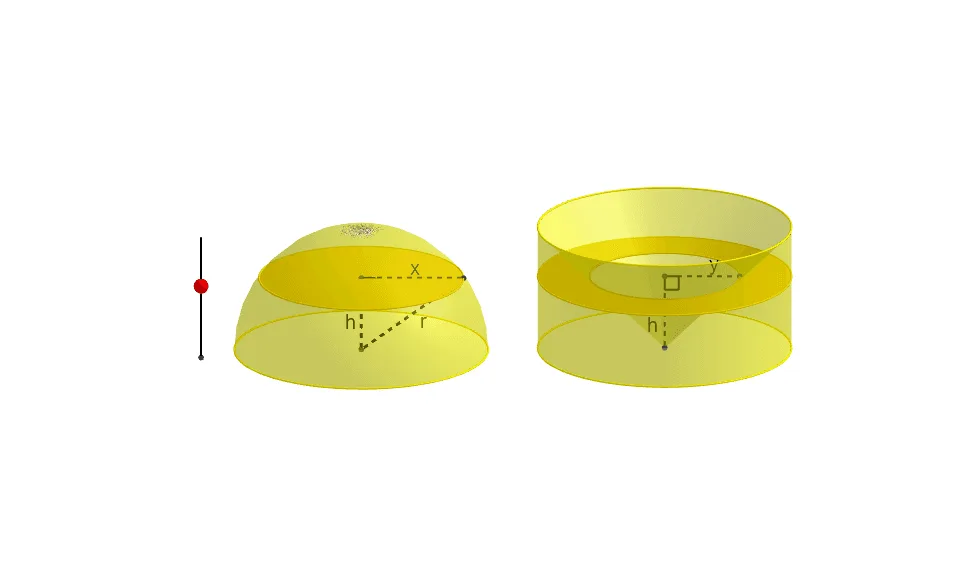
This example dynamically illustrates the derivation of the sphere volume formula. It involves core mathematical concepts such as sphere volume, integral ideas, limit concepts, and geometric construction. GeoGebra commands and objects used include Circle, Point, Sphere, Cylinder, Cone, Segment, OrthogonalPlane, IntersectPath, Intersect, Rotate, Polygon, Sequence, Angle, and Surface. Suitable for high school solid geometry and introductory calculus, helping students visually understand the origin of the volume formula.
GeoGebra Commands & Parameters
Circle(A, 1) → cCircle(B, 1) → dPoint(c) → CSphere(A, C) → aCylinder(B, D, 1) → b, e, f, gCone(D, B, 1) → h, k, iSegment(E, E + (0, 0, 1)) → jPoint(j) → FOrthogonalPlane(F, j) → lIntersectPath(l, a) → pIntersectPath(l, h) → qIntersectPath(l, b) → rPoint(q) → HIntersect(Ray[G, H], r) → I,Rotate(H, α, G) → H'Rotate(I, α, G) → I'Polygon(H, H', I', I) → poly1, h_1, h', i', i_1Sequence(Rotate[poly1, (k * α), G], k, 0, n) → list1Intersect(Ray[J, J + (1, 0, 0)], p) → K,Segment(A, J) → sSegment(J, K) → tSegment(K, A) → a_1Intersect(Ray[G, G + (1, 0, 0)], q) → L, MSegment(B, G) → b_1Segment(G, L) → c_1Circle(s, C) → d_1Angle(A, J, K) → βAngle(B, G, L) → γCircle(B, 1, Segment[B, B + (0, 0, 1)]) → e_1Surface((sqrt(1 - h^(2)) * cos(θ)) + x(A), (sqrt(1 - h^(2)) * sin(θ)) + y(A), h, θ, 0, 6.28319, h, 0, 1) → o
AI Drawing Prompt Reference
Draw a sphere with center A and radius 1. Then draw a cylinder with base center B and height 1. Next, draw a cone with base center B and height 1. Construct a plane perpendicular to the cylinder's base and intersect it with the sphere, cylinder, and cone to get a series of cross-sections. Rotate these cross-sections to form a 3D shape, illustrating the derivation of the sphere volume formula.
The prompt above was compiled from the original drawing commands and is for reference only.