
Resultant Force of Two Forces
Loading the math board and drawing, please wait…
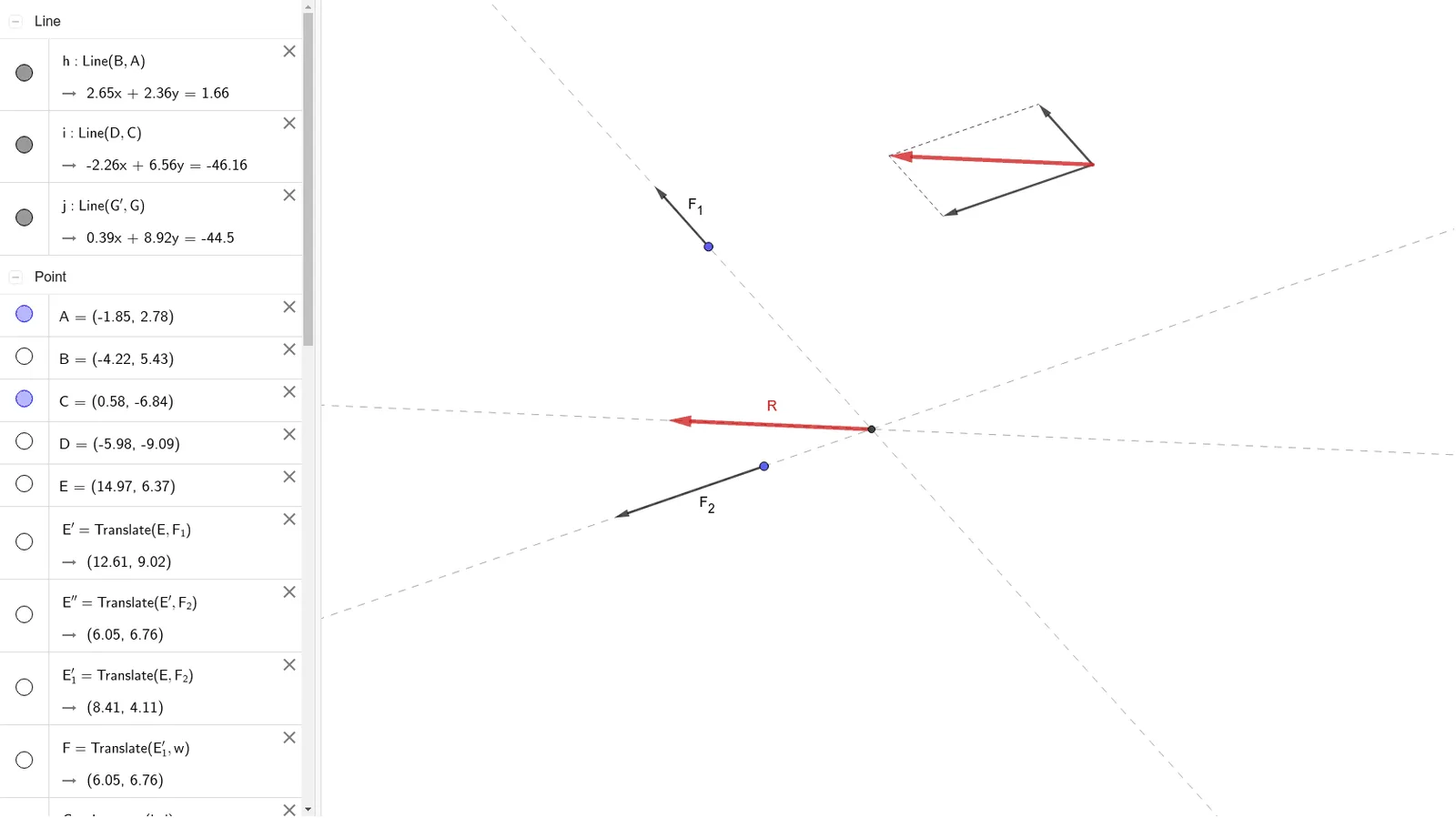
This example demonstrates the resultant force of two forces through vector addition, illustrating the principle of force composition. Key math concepts include vectors, force composition, and coordinate geometry. It uses commands like Vector, Translate, Segment, Line, and Intersect in GeoGebra. Suitable for high school physics and mathematics education to understand vector operations and force composition.
GeoGebra Commands & Parameters
Vector(A, B) → F_1Vector(C, D) → F_2Translate(E, F_1) → E'Vector(E, E') → wTranslate(E, F_2) → E'_1Vector(E, E'_1) → aTranslate(E', F_2) → E''Vector(E', E'') → bTranslate(E'_1, w) → FVector(E'_1, F) → cVector(E, E'') → dSegment(E'_1, F) → fSegment(F, E') → gLine(B, A) → hLine(D, C) → iIntersect(h, i) → GTranslate(G, d) → G'Vector(G, G') → RLine(G', G) → j
AI Drawing Prompt Reference
Draw two force vectors and demonstrate their resultant force through vector addition, illustrating the principle of force composition. First, draw two force vectors, then translate one vector to the starting point of the other, connecting these points to form two new vectors. Translate one of the new vectors and connect the starting and ending points to get the resultant force vector. Finally, draw the lines of action for the forces, find their intersection point, translate this point to the endpoint of the resultant force, and connect these points to form the opposite vector of the resultant force.
The prompt above was compiled from the original drawing commands and is for reference only.