
Resolving Forces Down a Plane with Friction Analysis
Loading the math board and drawing, please wait…
In collections
How to (4): Vectors, CAS and 3D views
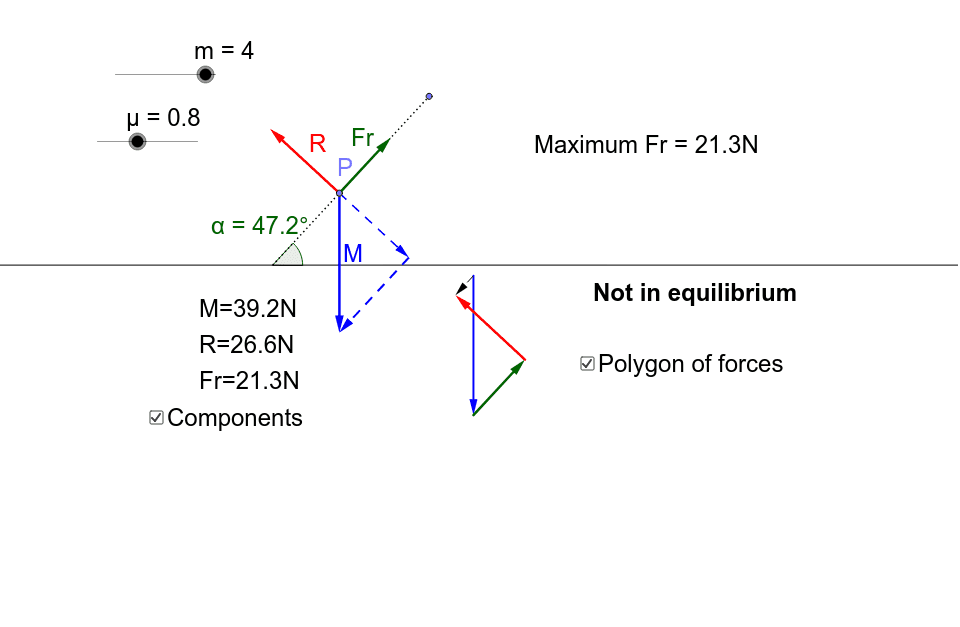
① This GeoGebra example dynamically demonstrates the resolution of gravitational force into components parallel and perpendicular to an inclined plane, and compares the required friction with the maximum possible static friction to determine whether the object slides. ② Core mathematical concepts include vector decomposition, coefficient of friction μ, maximum static friction Frmax = μN, force equilibrium, and critical conditions for impending motion. ③ Construction highlights: using GeoGebra commands such as Intersect, Point, Circle, Angle, Segment, Line, Translate, Vector, OrthogonalLine, Length, and Min to build the plane, object, weight vector, normal force, friction vector, and interactive sliders for μ and incline angle α, allowing real-time visualization of how changing parameters affects the friction threshold. ④ Suitable for high school physics or introductory university mechanics, ideal for teaching force resolution on inclined planes and the role of friction in static equilibrium, as well as for interdisciplinary math-physics exploration.
GeoGebra Commands & Parameters
Intersect(xAxis, yAxis) → APoint(xAxis) → BCircle(A, B) → cPoint(c) → CAngle(B, A, C) → αSegment(A, C) → aLine(A, B) → bPoint(a) → PTranslate(P, v_M) → D'Vector(P, D') → MOrthogonalLine(P, a) → dOrthogonalLine(D', d) → eIntersect(d, e) → EVector(P, E) → M_oVector(E, D') → M_pTranslate(P, v) → D'_1Vector(P, D'_1) → RTranslate(P, u) → D'_2Vector(P, D'_2) → Fr_1Translate(D, M) → D'_3Vector(D, D'_3) → wLength(M) → MvalLength(R) → RvalLength(Fr_1) → FrvalMin(Frval, Frmax) → Fr1Circle(A, Fr1) → kIntersect(k, a) → G,Vector(A, G) → iTranslate(P, i) → P'Vector(P, P') → FrTranslate(D'_3, Fr) → FVector(D'_3, F) → zTranslate(F, R) → F'Vector(F, F') → gVector(D, F') → resultantLength(resultant) → reslength
AI Drawing Prompt Reference
Draw an inclined plane with a labeled angle and place an object on it. From the object's center of gravity, draw the gravitational force vector and decompose it into components parallel and perpendicular to the plane. Also, draw the normal force perpendicular to the plane and the maximum static friction force along the plane. Use sliders to adjust the friction coefficient and the incline angle to show whether the object slides. Represent the range of maximum static friction with a dashed circle; the object remains static if the resultant force is within the circle, otherwise it slides.
The prompt above was compiled from the original drawing commands and is for reference only.