
Representing a Prism
Loading the math board and drawing, please wait…
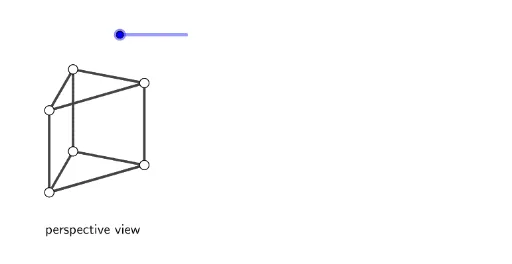
This example demonstrates how to construct a 3D prism model using GeoGebra, involving core math concepts like polygons, vectors, and solid geometry. Key GeoGebra commands used include Polygon, Segment, and Vector, making it suitable for high school students and teachers learning solid geometry.
GeoGebra Commands & Parameters
Polygon(A, B, C) → driehoek1, c, a, bPolygon(D, E, F) → driehoek2, f, d, eSegment(D, A) → gSegment(F, C) → hSegment(E, B) → iPolygon(G, H, 3) → veelhoek1, j, k, l, IPolygon(J, K, 3) → veelhoek2, m, n, p, LVector(A, J) → uVector(B, K) → vVector(C, L) → wVector(D, G) → qVector(E, H) → rVector(F, I) → tPolygon(AA, BB, CC) → driehoek3, cc, aa, bbPolygon(DD, EE, FF) → driehoek4, ff, dd, eeSegment(CC, FF) → f_1Segment(DD, AA) → g_1Segment(EE, BB) → h_1
AI Drawing Prompt Reference
Draw a 3D prism model with two parallel triangular bases and three rectangular lateral faces, demonstrating the geometric construction of the prism, start by drawing the triangular bases, then connect corresponding vertices to form the rectangular sides, and finally use vectors to represent the edges and directions of the prism.
The prompt above was compiled from the original drawing commands and is for reference only.