
Repeated Translations: A Triangular Step Chain
Loading the math board and drawing, please wait…
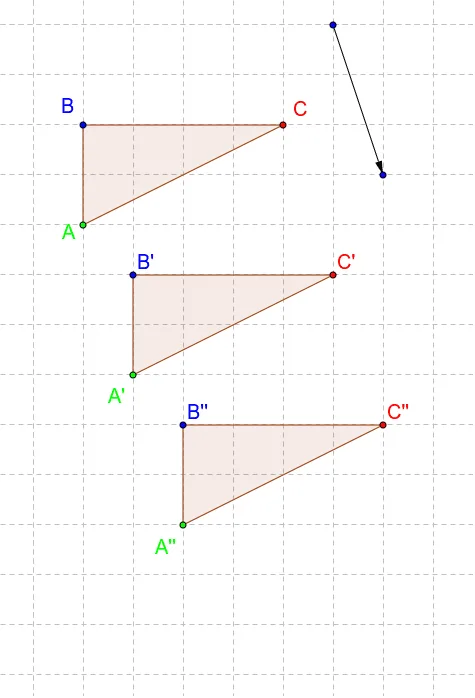
This example demonstrates how to repeatedly translate a triangle using a vector step, producing a chain of congruent, correspondingly positioned triangles. It highlights the geometric phenomenon of translation repeatedly applied in the same direction, making it easy to relate multiple translated copies and observe their structured relationships. The core mathematics includes vectors as translation instructions, geometric translation (Translation), triangle correspondence under rigid motion, and the role of arithmetic mean in interpreting related quantities. Construction-wise, GeoGebra uses Polygon and Vector to build the initial triangle (e.g., A, B, C and poly1) and define the translation vector (such as u). Then Translate is applied multiple times to obtain translated images A′, B′, C′ (poly1′) and further A″, B″, C″ (poly1″). It is suitable for secondary-level geometry and vector transformation lessons, as well as for exploratory activities on sequences/iteration of geometric transformations.
GeoGebra Commands & Parameters
Polygon(A, B, C) → poly1, c, a, bVector(D, E) → uTranslate(A, u) → A'Translate(B, u) → B'Translate(C, u) → C'Polygon(A', B', C') → poly1', c', a', b'Translate(A', u) → A''Translate(B', u) → B''Translate(C', u) → C''Polygon(A'', B'', C'') → poly1'', c'', a'', b''
AI Drawing Prompt Reference
Draw a triangle ABC, then repeatedly translate it using vector u in the same direction and distance to generate a series of congruent triangles in corresponding positions. First, draw triangle ABC, then define vector u, and translate points A, B, C to get A', B', C'. Next, translate A', B', C' to get A'', B'', C''. Finally, draw the two triangles.
The prompt above was compiled from the original drawing commands and is for reference only.