
Relationship Between Parallel Lines and Angles
Loading the math board and drawing, please wait…
In collections
PARCC Math I Unit 5 Lesson 5
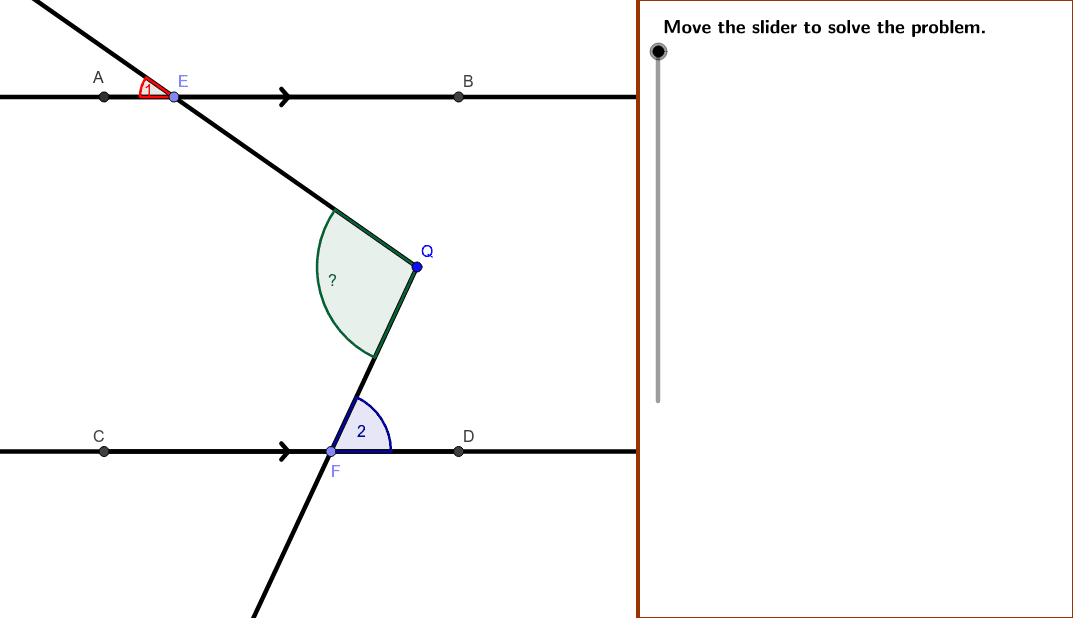
This example demonstrates the angle relationships between parallel lines AB and CD, where the measure of ∠1 is 35°. By constructing angles, segments, and polygons, it helps students understand the properties of parallel lines and angle relationships. It uses commands such as Point, Polygon, Segment, Line, Ray, and Angle in GeoGebra. Suitable for Grade 7 students learning geometric construction.
GeoGebra Commands & Parameters
Point(xAxis) → F_1Polygon((x(F_1), y(Corner[1])), Corner[2], Corner[3], (x(F_1), y(Corner[4]))) → poly1, c, d, e, fSegment(G, H) → gPoint(g) → ILine(A, B) → aLine(C, D) → bPoint(a) → EPoint(b) → FSegment(A, B) → hSegment(C, D) → iRay(Q, E) → jRay(Q, F) → kPoint(j) → KAngle(K, E, A) → αAngle(D, F, Q) → βAngle(E, Q, F) → γLine(Q, a) → lPoint(l) → PAngle(E, Q, P) → δAngle(P, Q, F) → εAngle(E, Q, P) → ζAngle(P, Q, F) → ηTableText({{"\mathit{m}\angle\mathit{EQF}", "=", "\mathit{m}\angle\mathit{EQP}+\mathit{m}\angle\mathit{FQP}"}, {"\mathit{m}\angle\mathit{EQF}", "=", "\mathit{m}\angle1+\mathit{m}\angle2"}, {"\mathit{m}\angle\mathit{EQF}", "=", ((α * "+") * β)}, {"\mathit{m}\angle\mathit{EQF}", "=", α + β}}, "rcl") → text8TableText({{"\angle1", "\cong", "\angle\mathit{EQP}"}, {"\mathit{m}\angle1", "=", "\mathit{m}\angle\mathit{EQP}"}}, "rcl") → text9TableText({{"\angle2", "\cong", "\angle\mathit{FQP}"}, {"\mathit{m}\angle2", "=", "\mathit{m}\angle\mathit{FQP}"}}, "rcl") → text10
AI Drawing Prompt Reference
Draw two parallel lines AB and CD with angle 1 measuring 35°. Construct a quadrilateral between the lines AB and CD, marking key points E and F on the lines. From point Q, draw rays to lines AB and CD, forming angles α, β, and γ. Then, draw rays from Q to segment EF, forming angles δ and ε. Finally, label the text to show that the sum of angles α and β equals angle 1, and angle EQF equals the sum of angles EQP and FQP.
The prompt above was compiled from the original drawing commands and is for reference only.