
Relationship Between Circular Motion and Waves
Loading the math board and drawing, please wait…
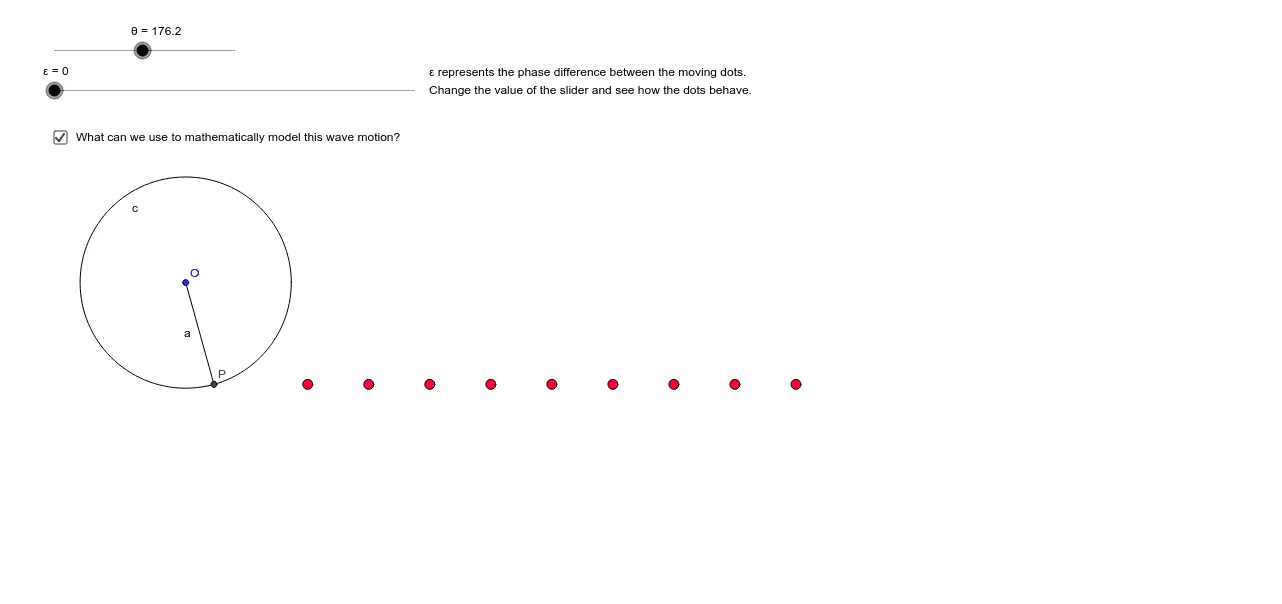
This example illustrates the relationship between circular motion and waves. By constructing circular motion geometrically, we can intuitively understand the formation of waves. Key mathematical concepts include circles, trigonometric functions, and vectors. GeoGebra commands used include Circle, Point, Rotate, Angle, Segment, etc. Suitable for high school physics and mathematics education.
GeoGebra Commands & Parameters
Circle(O, B) → cPoint(c) → CRotate(C, θ, O) → PAngle(C, O, P) → αSegment(O, P) → aSegment(O, C) → bOrthogonalLine(C, b) → dPoint(d) → AOrthogonalLine(A, d) → eOrthogonalLine(P, e) → fIntersect(f, e) → QLine(C, O) → gIntersect(c, g) → D, ESegment(C, E) → hMidpoint(C, A) → FMirror(F, A) → F'Mirror(A, F') → A'Mirror(F', A') → F''Mirror(A', F'') → A''Mirror(F'', A'') → F'''Mirror(A'', F''') → A'''Mirror(F''', A''') → GMirror(A''', G) → HOrthogonalLine(F', d) → iOrthogonalLine(A', d) → jOrthogonalLine(F'', d) → kOrthogonalLine(A'', d) → lOrthogonalLine(F''', d) → mOrthogonalLine(A''', d) → nOrthogonalLine(G, d) → pOrthogonalLine(H, d) → qRotate(P, ε°, O) → P'_1Angle(P, O, P'_1) → βRotate(P, 2.0 * ε°, O) → P'_2Angle(P, O, P'_2) → γRotate(P, 3.0 * ε°, O) → P'_3Angle(P, O, P'_3) → δRotate(P, 4.0 * ε°, O) → P'_4Angle(P, O, P'_4) → ζRotate(P, 5.0 * ε°, O) → P'_5Angle(P, O, P'_5) → ηRotate(P, 6.0 * ε°, O) → P'_6Angle(P, O, P'_6) → ιRotate(P, 7.0 * ε°, O) → P'_7Angle(P, O, P'_7) → μOrthogonalLine(P'_1, i) → rOrthogonalLine(P'_2, j) → sOrthogonalLine(P'_3, k) → tOrthogonalLine(P'_4, l) → a_1OrthogonalLine(P'_5, m) → b_1OrthogonalLine(P'_6, n) → c_1OrthogonalLine(P'_7, q) → e_1Intersect(r, i) → IIntersect(s, j) → JIntersect(t, k) → KIntersect(a_1, l) → LIntersect(b_1, m) → MIntersect(c_1, n) → NIntersect(e_1, p) → RRotate(P, 8.0 * ε°, O) → P'_8Angle(P, O, P'_8) → κOrthogonalLine(P'_8, q) → d_1Intersect(d_1, q) → S
AI Drawing Prompt Reference
Draw a circle O and take a point C on it. Rotate C around O to form point P. Construct a line segment from C to O, and on the circle, take points D and E. Draw a line segment from C to E, and construct a line d perpendicular to this segment. Through P and d, construct a series of perpendicular lines, and rotate P to form points P'_1 to P'_7, and draw perpendicular lines from these points to d.
The prompt above was compiled from the original drawing commands and is for reference only.