
Conical Pendulum and Uniform Circular Motion
Loading the math board and drawing, please wait…
In collections
El dominio del Tiempo (cinemática intuitiva)
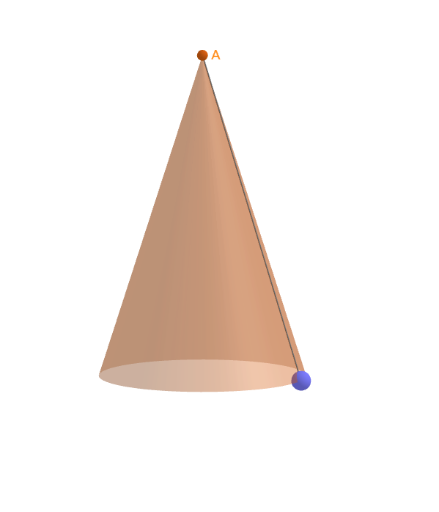
This GeoGebra example demonstrates a conical pendulum: a mass moving in a horizontal circle while the pendulum string sweeps out a conical surface. Core mathematical concepts covered: (1) uniform circular motion with angular velocity, period and centripetal force; (2) vector decomposition of gravitational force and tension; (3) trigonometric relationships between swing angle, height, length and radius; (4) geometric properties of a cone. Construction highlights: Circle for the circular path, Vector for force diagrams, Angle for measuring the swing angle, Cone command to generate the conical surface, with sliders for angular velocity ω and animation controls. Ideal for high school physics (mechanics) and introductory university physics courses illustrating circular motion and vector analysis.
GeoGebra Commands & Parameters
Circle(O, l) → cirPoint(cir) → MLine(O, M) → rrPoint(Segment[(0, 0, 1), (0, 0, 25)]) → ALine(A, M) → mLine(M + g, m) → qSegment((0, 0, 0), A) → hSegment(O, M) → rIf(Length[reg] ≟ 1, {reg(1)}, Sequence[reg(k) - reg(k + 1), k, 1, Length[reg] - 1]) → regDifmean(regDif) → TSegment(A, M) → jOrthogonalPlane(M - g, g) → pIntersect(p, m) → BIntersect(q, rr) → CVector(M, C) → cVector(M, B) → ThiloAngle((10, 0), O, Rotate[(10, 0), ω]) → αCone(Circle[O, l], h) → a, d, bVector(M, M - g) → g'Segment(O, M) → r'
AI Drawing Prompt Reference
Draw a graph that describes the oscillation of a conical pendulum, including a circular oscillation path, a center of mass, a vertical force vector, a cone, an angle measurement, and a line segment from the center of mass to the vertex of the cone. The circular oscillation path is defined by a center and a radius, the center of mass is a point, the vertical force vector is a line segment from the center of mass to the vertex of the cone, the cone is defined by the circular oscillation path and the line segment from the center of mass to the vertex of the cone, the angle measurement is the angle between the circular oscillation path and the center of mass, and the line segment from the center of mass to the vertex of the cone is a line segment from the center of mass to the vertex of the cone.
The prompt above was compiled from the original drawing commands and is for reference only.