
Relation between Pentagonal and Triangular Numbers
Loading the math board and drawing, please wait…
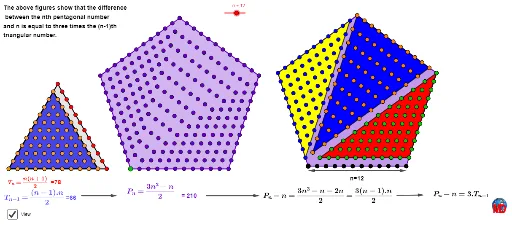
① This GeoGebra example dynamically illustrates the algebraic relationship between pentagonal numbers and triangular numbers, showing how the nth pentagonal number can be expressed as a combination of triangular numbers. ② Core mathematical concepts include polygonal numbers (pentagonal and triangular), integer sequences, sums of arithmetic progressions, and geometric constructions involving equilateral triangles and pentagons via translation and tiling. ③ Construction highlights: using GeoGebra commands such as Sequence, Join, Take, Translate, Element, Polygon, Vector, Line, Intersect, and Midpoint, the applet builds triangular grids and pentagonal arrays, translates triangular units to form pentagons, and displays the numerical relations with text objects. ④ Suitable for upper secondary or early university students, this example supports exploration of number theory through geometric intuition and can be used in math labs or inquiry-based learning.
GeoGebra Commands & Parameters
Sequence(Vector[C, C + (cos((i * (360°) / 5)), sin((i * (360°) / 5)))], i, 0, 5 - 1) → list3bSequence(Vector[Sum[Take[list3b, 1, i]]], i, 1, 5) → list3cJoin({{C + (0, 0)}, Sequence[Sequence[Sequence[C + (0, 0) + (i * Element[list3c, t]) + (j * Element[list3b, t + 1]), j, 0, i], i, 1, n - 1], t, 1, 3]}) → list3Sequence(Polygon[C + (0, 0), C + (i, 0), 5], i, 1, n - 1) → l4Sequence(Vector[C, C + (cos((i * (360°) / 3)), sin((i * (360°) / 3)))], i, 0, 3 - 1) → l2bSequence(Vector[Sum[Take[l2b, 1, i]]], i, 1, 3) → l2cTake(list3, Length[list3] - 2, Length[list3] - 1) → l2Take(list3, Length[list3] - 1, Length[list3]) → l5Translate(C, Vector[((n - 1) * Element[list3b, 1]) + ((n - 1) * Element[list3b, 2])]) → C'Join(list3) → l6Join(Join[Sequence[Sequence[Sequence[C + (0, 0) + (i * Element[list3c, t]) + (j * Element[list3b, t + 1]), j, 0, i], i, 1, n - 1], t, 1, 3]]) → l7Element(l7, 2) → DPolygon(C', D, E) → t2, e_1, c', dElement(l7, n^(2)) → HPolygon(J, H, I) → t1, i, j, hSequence(Polygon[C + (0, 0), C + (i, 0), 5], i, n - 1, n - 1) → liste3Take(list3, 1, Length[list3] - 2) → l3Element(l7, Length[l7]) → KVector(Element[l7, Length[l7]], Element[l7, Length[l7] - 1]) → uLine(L, h) → fLine(K, C) → gIntersect(f, g) → MPolygon(L, K, M) → t3, m_1, l_1, kSequence(Translate[C, Vector[(i * Element[list3b, 1])]], i, 0, n - 1) → l8Midpoint(A_1, N) → OVector(O, N) → vVector(O, A_1) → wSequence(Vector[A, A + (cos((i * (360°) / 3)), sin((i * (360°) / 3)))], i, 0, 3 - 1) → list1bSequence(Vector[Sum[Take[list1b, 1, i]]], i, 1, 3) → list1cSequence(Polygon[A + (0, 0), A + (i, 0), 3], i, n - 1, n - 1) → l10Join({{A + (0, 0)}, Sequence[Sequence[Sequence[A + (0, 0) + (i * Element[list1c, t]) + (j * Element[list1b, t + 1]), j, 0, i], i, 1, n - 1], t, 1, 1]}) → l9Translate(l7, Vector[C, P]) → l7'Join({{A + (0, 0)}, Sequence[Sequence[Sequence[A + (0, 0) + (i * Element[list1c, t]) + (j * Element[list1b, t + 1]), j, 0, i], i, 1, n - 2], t, 1, 1]}) → l9bSequence(Polygon[A + (0, 0), A + (i, 0), 3], i, n - 2, n - 2) → l11Translate(liste3, Vector[C, P]) → list3'Vector(Q, R) → aVector(S, T) → bVector(U, V) → cSequence(Polygon[A + (0, 0), A + (i, 0), 3], i, n - 2, n - 2) → l12
AI Drawing Prompt Reference
Create a dynamic geometric diagram illustrating the algebraic relationship between pentagonal and triangular numbers. The figure includes a pentagonal array formed by translating and tiling equilateral triangular units, alongside a triangular grid. Multiple polygons, vectors, and intersection points are shown, with a symmetric layout that visually compares the recursive relationship between pentagonal and triangular numbers.
The prompt above was compiled from the original drawing commands and is for reference only.