
Regular Polygon Combinations
Loading the math board and drawing, please wait…
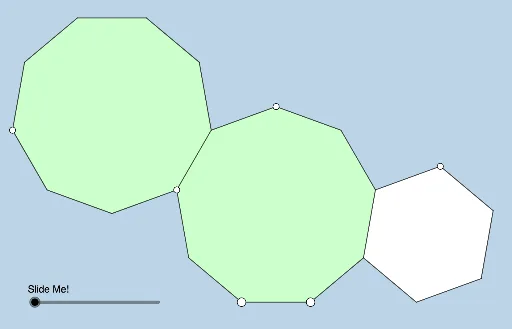
This example demonstrates the combination of two regular nonagons and one regular hexagon, exploring how they fit together to form a specific pattern. Core math concepts include properties of regular polygons, geometric tiling, trigonometric calculations, and transformations. Construction highlights involve commands like Polygon, Segment, Dilate, Vector, and Translate in GeoGebra. Suitable for high school and above, ideal for understanding geometric transformations and combinatorial geometry.
GeoGebra Commands & Parameters
Polygon(A, B, 9) → poly1, f, C, D, E, F, G, H, I, g, h, i, j, k, l, m, nPolygon(D, C, 6) → poly3, a, Q, b, c, d, e, f_1, N, O, PPolygon(H, G, 9) → poly4, g_1, R, S, T, U, V, W, Z, h_1, i_1, j_1, k_1, l_1, m_1, n_1, p_1Segment(A, B) → qSegment(B, C) → rSegment(C, N) → sSegment(N, O) → tSegment(O, P) → a_1Segment(P, Q) → b_1Segment(Q, D) → c_1Segment(D, C) → d_1Segment(A, I) → e_1Segment(I, H) → f_2Segment(H, G) → g_2Segment(G, F) → h_2Segment(F, E) → i_2Segment(E, D) → j_2Segment(H, Z) → k_2Segment(Z, W) → l_2Segment(W, V) → m_2Segment(V, U) → n_2Segment(U, T) → p_2Segment(T, S) → q_2Segment(S, R) → r_2Segment(R, G) → s_2Dilate(H, If[1 < o ≤ 2, 2 - o, 0], V) → H'Segment(H, H') → r_1Dilate(Q, If[0 < o ≤ 1, 1 - o, 0], H) → Q'Segment(Q, Q') → t_1Dilate(H, If[2 < o ≤ 3, 3 - o, 0], V) → H'_1Vector(H, H'_1) → uTranslate(Q, u) → Q'_1Translate(Q', u) → Q''Segment(Q'_1, Q'') → pDilate(H, If[3 < o ≤ 4, 4 - o, 0], Q) → H'_2Vector(H, H'_2) → vTranslate(H, v) → H'_3Translate(H', v) → H''Segment(H'_3, H'') → q_1Polygon(Q, H, V, F) → q1, q_3, h_3, v_1, f_3
AI Drawing Prompt Reference
Draw a pattern formed by combining two regular nonagons and one regular hexagon, showing how they fit together. Start by drawing the three regular polygons, then connect their edges to create a complex geometric structure. Use dilation and translation transformations to scale and move one of the nonagons, combining it with the other nonagon and hexagon to form a symmetrical geometric design.
The prompt above was compiled from the original drawing commands and is for reference only.