
Regular Nonagon Inner Angles and Construction
Loading the math board and drawing, please wait…
In collections
Regular Polygons
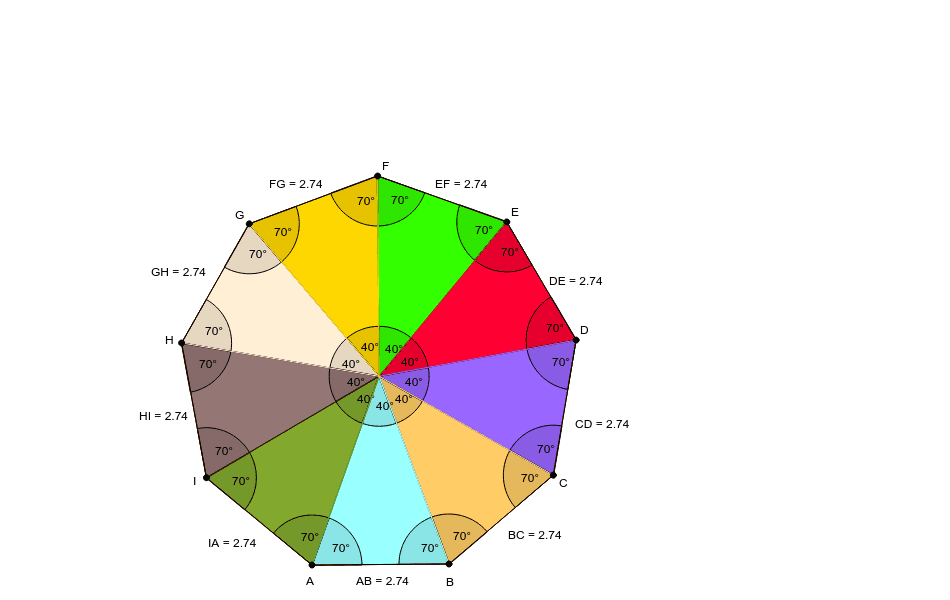
This example demonstrates the inner angles of a regular nonagon and its geometric construction. Key math concepts include polygons, inner angles, and geometric construction. It uses commands like Polygon, Rotate, Angle, Ray, Intersect, and Segment in GeoGebra. Suitable for high school students to learn and understand polygonal geometric properties, ideal for teaching demonstrations and geometric construction practice.
GeoGebra Commands & Parameters
Polygon(A, B, 9) → poly1, a, C, D, E, F, G, H, I, b, c, d, e, f, g, h, iRotate(B, 70*°, A) → B'Angle(B, A, B') → αRotate(A, -70*°, B) → A'Angle(A', B, A) → βRay(A, B') → jRay(B, A') → kIntersect(j, k) → JSegment(J, C) → lSegment(J, D) → mSegment(E, J) → nSegment(F, J) → pSegment(J, G) → qSegment(H, J) → rSegment(J, I) → sSegment(J, B) → tSegment(J, A) → a_1Angle(A, J, B) → γAngle(B, J, C) → δAngle(C, B, J) → εAngle(J, C, B) → ζAngle(J, D, C) → ηAngle(C, J, D) → θAngle(D, C, J) → ιAngle(J, E, D) → κAngle(E, D, J) → λAngle(D, J, E) → μAngle(E, J, F) → νAngle(J, F, E) → ξAngle(F, E, J) → οAngle(J, G, F) → ρAngle(G, F, J) → σAngle(F, J, G) → τAngle(J, H, G) → υAngle(H, G, J) → ϕAngle(G, J, H) → χAngle(J, I, H) → ψAngle(I, H, J) → ωAngle(H, J, I) → α_1Angle(A, I, J) → β_1Angle(I, J, A) → γ_1Angle(J, A, I) → δ_1Polygon(F, E, J) → poly2, EF, f_1, e_1Polygon(E, D, J) → poly3, DE, e_2, d_1Polygon(D, C, J) → poly4, CD, d_2, c_1Polygon(J, C, B) → poly5, b_1, BC, c_2Polygon(J, B, A) → poly6, a_2, AB, b_2Polygon(J, A, I) → poly7, i_1, IA, a_3Polygon(J, I, H) → poly8, h_1, HI, i_2Polygon(G, J, H) → poly9, h_2, g_1, GHPolygon(F, G, J) → poly10, FG, f_2, g_2
AI Drawing Prompt Reference
Draw a regular nonagon and display its inner angles. First, construct the nonagon, then rotate one of its sides by 70 degrees around the adjacent vertex to find a new point. Measure and label all inner angles. Extend rays from the new point to each side of the nonagon, meeting at a point. Connect this point to all vertices of the nonagon, labeling the angles formed, and color-code different sections for clarity.
The prompt above was compiled from the original drawing commands and is for reference only.