
Refraction on Parallel Surfaces by Barb Newitt
Loading the math board and drawing, please wait…
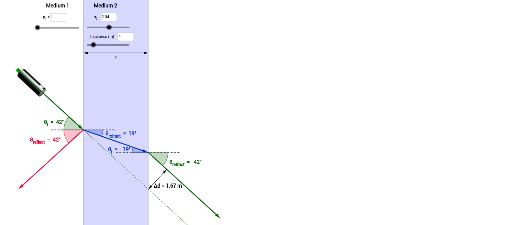
This example demonstrates the refraction of light through parallel surfaces, illustrating key mathematical concepts like Snell's Law, angle calculations, and vector operations. It utilizes GeoGebra commands such as Point, Line, Intersect, OrthogonalLine, Segment, Angle, Rotate, Vector, Circle, AngularBisector, Mirror, Ray, Distance, and Midpoint for construction. Suitable for high school physics and mathematics education to explore refraction principles and geometric constructions.
GeoGebra Commands & Parameters
Point(yAxis) → FPoint(yAxis) → ELine(E, F) → gIntersect(xAxis, yAxis) → DOrthogonalLine(D, g) → hPoint(h) → KSegment(A, B) → fIntersect(h, f) → GPoint(f) → CAngle(G, D, C) → βAngle(C, D, G) → αIf(α > 90°, β, α) → γRotate(K, a, D) → K'Line(D, K') → g_1Polygon(R, S, T, U) → poly2, r, s, t_1, u_1Intersect(g_1, t_1) → VVector(C, D) → uCircle(D, 1.2) → cAngularBisector(C, D, G) → iIntersect(c, i, 2) → HMirror(C, h) → C'Vector(D, C') → vAngularBisector(C', D, G) → jIntersect(c, j, 2) → IAngle(C', D, G) → δAngle(G, D, C') → εIf(δ > 90°, ε, δ) → ζCircle(D, 1.8) → dIntersect(d, j, 2) → JAngle(K, D, K') → ηRotate(K, (-a), D) → K'_1Angle(K'_1, D, K) → θAngularBisector(K'_1, D, K) → kAngularBisector(K, D, K') → lIntersect(c, k, 2) → LIntersect(c, l, 2) → MVector(D, K'_1) → wVector(D, K') → bPolygon(N, O, P, Q) → poly1, n, o, p, qTextfield(n_1) → InputBox1Textfield(n_2) → InputBox2Line(C, D) → mOrthogonalLine(C, m) → f_1Circle(C, 0.6) → eIntersect(e, f_1, 2) → ZIntersect(e, f_1, 1) → A_1Line(D, K'_1) → h_1Intersect(h_1, t_1) → WVector(D, V) → v_1Vector(D, W) → w_1Rotate(B_1, (-γ), W) → C_1Angle(C_1, W, B_1) → νPoint(h) → D_1Point(h) → E_1Segment(D_1, E_1) → i_1Vector(W, C_1) → a_1Rotate(G_1, γ, V) → F_1Angle(G_1, V, F_1) → ξVector(V, F_1) → b_1Ray(C, D) → j_1Segment(H_1, I_1) → k_1Segment(J_1, K_1) → l_1AngularBisector(F_1, V, G_1) → m_1AngularBisector(B_1, W, C_1) → p_1Circle(W, 1) → c_1Circle(V, 1) → d_1Intersect(d_1, m_1, 2) → L_1Intersect(c_1, p_1, 2) → M_1Angle(D, W, J_1) → οAngle(H_1, V, D) → ρAngularBisector(J_1, W, D) → q_1AngularBisector(D, V, H_1) → r_1Intersect(d_1, r_1, 2) → N_1Intersect(c_1, q_1, 2) → O_1Intersect(t_1, j_1) → P_1OrthogonalLine(P_1, j_1) → s_1Line(W, C_1) → e_1Intersect(s_1, e_1) → Q_1Distance(P_1, Q_1) → distanceP1Q1Textfield(t) → InputBox3Midpoint(P_1, Q_1) → R_1Vector(P_1, Q_1) → u_2Vector(Q_1, P_1) → v_2Line(F_1, V) → f_2Intersect(f_2, s_1) → S_1Midpoint(P_1, S_1) → T_1Vector(S_1, P_1) → w_2Vector(P_1, S_1) → a_2Distance(P_1, S_1) → o_1Distance(P_1, S_1) → b_2Point(r) → U_1Point(t_1) → V_1Vector(U_1, V_1) → c_2Vector(V_1, U_1) → d_2