
Reflection Property of a Hyperbolic Mirror
Loading the math board and drawing, please wait…
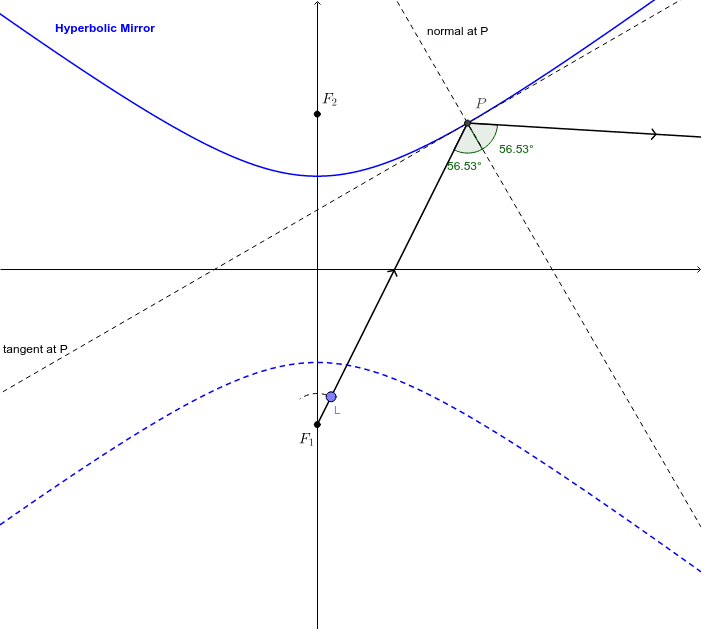
This applet demonstrates the reflection property of a hyperbolic mirror. Key mathematical concepts include hyperbolas and their reflection properties. By constructing hyperbolas, lines, tangents, etc., users can visually understand the reflection principle. Suitable for high school mathematics education and learning.
GeoGebra Commands & Parameters
Point(yAxis) → F_1Circle(F_1, 1) → dPoint(yAxis) → F_2Intersect(f, j, (-8, 6.708203932499369)) → WIntersect(f, k, (8, 6.708203932499369)) → YSegment(F_1, W) → aSegment(F_1, Y) → bIntersect(d, a) → X,Intersect(d, b) → Z,CircleArc(F_1, Z, X) → cPoint(c) → LRay(F_1, L) → eIntersect(f, e, (4.840930476051537, 4.709773553909473)) → PSegment(F_1, P) → hTangent(P, f) → iOrthogonalLine(P, i) → lRay(F_2, P) → mPoint(m) → APoint(l) → BSegment(P, A) → nAngle(F_1, P, B) → αAngle(B, P, A) → β
AI Drawing Prompt Reference
Draw a hyperbola with marked foci. Construct tangents and reflection lines from the foci. Create line segments from the foci to the hyperbola, and draw a circle centered at one focus intersecting these segments. Connect the intersection points to the focus. Draw an arc from the focus through these points, then a ray along the arc direction intersecting the hyperbola. Connect the focus to this intersection point. From the second focus, draw a ray intersecting the first ray, then a perpendicular from the intersection point to the tangent, meeting the hyperbola again. Connect the second focus to this new intersection point. Finally, measure the angles to illustrate the reflection property.
The prompt above was compiled from the original drawing commands and is for reference only.