
Reflection of a Pulse (Fixed End)
Loading the math board and drawing, please wait…
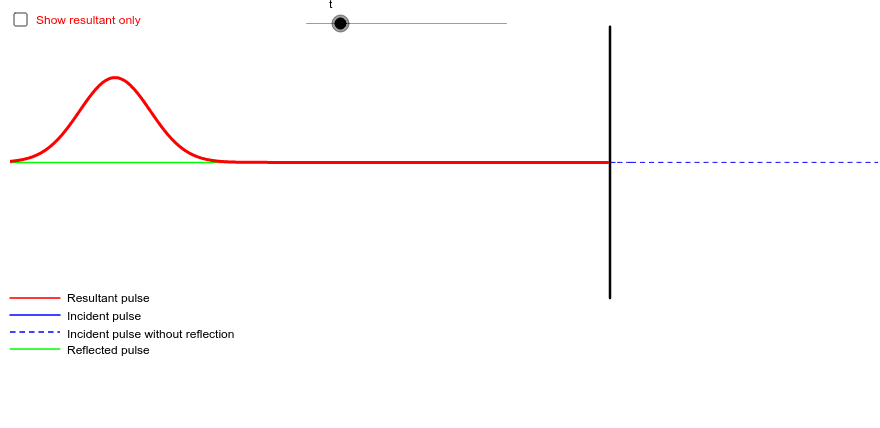
This example demonstrates the reflection of a 1-dimensional pulse from a fixed end. It involves core mathematical concepts like reflection laws, wave superposition, and slope analysis. Constructed using GeoGebra commands such as Polygon and Segment, it is suitable for high school physics or mathematics courses to understand wave reflection properties and dynamic demonstrations.
GeoGebra Commands & Parameters
Polygon(Gl1, Gl2, Gl3, Gl4) → glpoly, gl1, gl2, gl3, gl4Polygon(Gr1, Gr2, Gr3, Gr4) → grpoly, gr1, gr2, gr3, gr4Segment(Gr1, Gr4) → ReflectorSegment(A, B) → cSegment(C, D) → dSegment(E, F) → fSegment(G, H) → g
AI Drawing Prompt Reference
Draw a graph of a one-dimensional pulse reflecting from a fixed end. The graph should include a polygon representing the pulse shape, a reflector as the fixed end, and several line segments showing the pulse path and related relationships. The construction order is: first draw the polygon, then the reflector, and finally add the line segments to illustrate the reflection process and slope analysis.
The prompt above was compiled from the original drawing commands and is for reference only.